
Gun cleaning mats for preppers: complete 2026 guide
Preppers’ gun cleaning mats are dedicated work surfaces for firearm maintenance, with the aim of keeping your cleaning setup organized and ready to use. This 2026 guide focuses on choosing a mat for the bench you actually have, containing loose parts, and packing the setup away without turning your kitchen table into a permanent gunsmithing experiment.
- Choose a gun cleaning mat for preppers by workspace fit, documented materials, and cleanup requirements—not artwork alone.
- Stickthison gun cleaning mats suit gun owners who want firearm-themed artwork on their maintenance bench.
- Use a parts tray and your firearm manual; a printed schematic replaces neither.
- Keep a home-bench setup separate from your field kit if the mat adds unnecessary bulk.
Why gun cleaning mats matter for preppers
Preparedness includes mundane maintenance, not just another pouch hanging off another pouch. A dedicated cleaning surface gives you a defined place to set tools and components, then clear them away when the job is finished. That matters when your workbench also serves as a storage shelf, folding table, or family dining table with an increasingly suspicious smell.
For a prepper, the buying decision has two competing demands: enough workspace at home and manageable bulk when equipment moves. Choose for the routine you will repeat, not the emergency scenario you have mentally cast yourself in. A big bench mat and a compact field kit do different jobs.
Stickthison sells gun cleaning mats alongside patches, stickers, and apparel. The useful distinction is between the artwork you like and the construction details you can verify. A firearm collage tells you what is printed on the mat; it does not tell you which cleaning chemicals the material tolerates.
Your 2026 setup should make ordinary maintenance easier before it earns space in an emergency kit. Start with the surface, the firearm manufacturer’s instructions, and a way to contain small parts. The joke on the mat comes after those decisions, not instead of them.
Build a cleaning setup that earns its space
1. Define where you will actually clean
Start without buying anything: clear your existing table and lay out the tools you already use. Keep ammunition out of the cleaning area, verify the firearm is unloaded according to its manual, and follow the manufacturer’s maintenance procedure. A mat is a workspace accessory, not a safety system.
Decide whether this is a permanent home bench, an occasional tabletop setup, or something you expect to carry. Those are separate use cases. Trying to make one arrangement perfect for all three is how a sensible kit becomes a tactical junk drawer with handles.
For a shared household surface, think beyond the firearm footprint. You need room for the cleaning supplies, a parts container, and your hands without parking everything on the table edge. Also follow the cleaning-product label’s ventilation and handling instructions; a garage is not automatically an appropriate chemical workspace.
- Identify your primary cleaning location before choosing a mat.
- Clear food, drinks, ammunition, and unrelated clutter from that area.
- Set aside the correct firearm manual and cleaning-product instructions.
- Reserve a separate spot for tools and contained parts.
- Decide whether the setup stays home or travels.
2. Measure the whole working layout
Use a tape measure and a paper outline before shopping. Measure the usable tabletop, then arrange the unloaded firearm’s field-stripped components as its manual directs. Include your parts tray and cleaning tools. Buy for the working layout, not the assembled firearm’s silhouette.
A mat that technically fits the gun but leaves every accessory hanging over the edge is not a well-planned workspace. Conversely, a mat that covers your entire folding table leaves nowhere for supplies that you want outside the dirty work area.
The supplied specifications for Gunsmith Mat (Firearm Collage) V2 list 36 × 18 inches and 18 × 16 inches. Those dimensions give you concrete outlines to test on your own table. They do not establish which size suits your firearm or whether the mat belongs in your pack.
For your 2026 shopping shortlist, write down the usable surface dimensions before comparing designs. An excellent-looking mat that hangs off the table still hangs off the table. Camouflage does not hide geometry.
- Measure usable width and depth, excluding clutter and damaged edges.
- Mock up a 36 × 18-inch footprint on the table.
- Compare it with an 18 × 16-inch footprint where appropriate.
- Leave a deliberate location for the parts tray.
- Check how the packed mat fits your intended storage space.
3. Separate construction facts from artwork
The manual approach is simple: make a short checklist and compare each product’s stated materials against it. Look for dimensions, backing, care instructions, and explicit cleaning-chemical compatibility. Do not translate a dramatic product name into imaginary performance specifications.
The supplied descriptions for Gunsmith Mat (Firearm Collage) V2 and Gunsmith Mat - Multicam Black specify 100% polyester and a rubber non-slip base. The Multicam Black description also lists a 36 × 18-inch size and edge stitching. Those are useful construction facts. They are not proof of solvent resistance, a liquid barrier, or heat tolerance.
Stickthison gun cleaning mats are best for gun owners who want firearm-themed artwork on their maintenance bench. Choose a documented size and construction first, then pick the graphic that makes you grin. That is a better shortcut than buying purely by artwork and discovering the practical questions afterward.
A schematic design, such as AR15 v2 Gunsmith Mat, adds an exploded-view backdrop. Treat it as a visual reference, not authority for your particular firearm’s maintenance procedure. Your manual still gets the final word, even when the diagram looks considerably cooler.
- Confirm the listed dimensions for the exact mat you choose.
- Check the stated surface material and backing separately.
- Look for explicit care and chemical-compatibility instructions.
- Treat schematics as supplementary references, not service manuals.
- Pick artwork only after the practical requirements check out.
These three mats illustrate different design choices: a firearm collage, a camouflage-style design, and an AR15 exploded-view backdrop. Their supplied descriptions do not establish identical construction across the entire range, so compare each item on its own facts.


4. Divide the surface into working zones
Use containers you already own to separate loose parts from cleaning supplies. Place components only where the firearm manual permits, and avoid spreading them across the entire table. Your mat should define the work area; your tray should contain the small stuff.
Build a layout with three named areas: Dirty work, Parts tray, and Clean tools. Keep the tray beside the mat, where you can reach it without dragging tools across components. Place clean brushes, patches, and other supplies away from the dirty work area until needed.
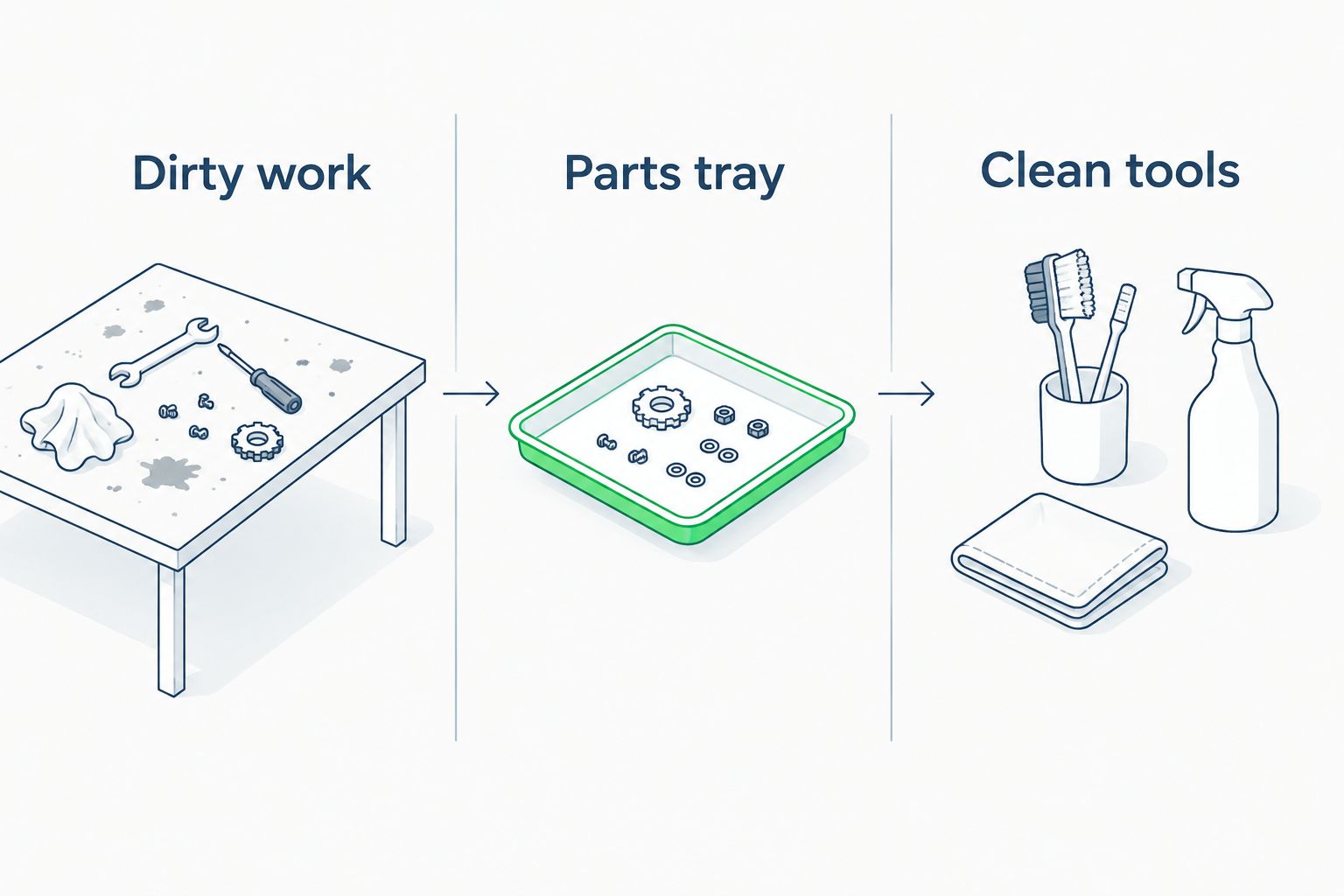
You do not need a new organizational gadget for every component. You need a consistent place to put things and the discipline to stop when something is missing. The floor is not a parts bin, regardless of how much time you have spent searching it.
- Mark out Dirty work on the main surface.
- Keep a Parts tray beside the mat.
- Reserve Clean tools for unused supplies.
- Follow the manual’s sequence rather than improvising disassembly.
- Account for removed components before clearing the workspace.
5. Plan cleanup before the first session
Start with the cleaning-product labels and the mat’s care instructions. Follow their handling, ventilation, and disposal directions. If compatibility is not explicitly stated, do not assume that a fabric surface, backing, or printed design tolerates the chemical you intend to use.
Keep a suitable container or work surface for chemical handling where the relevant instructions require one. A non-slip base is not a spill-containment claim. Neither is a stitched edge. A mat and a chemical tray have different jobs, and confusing them is an excellent way to explain a new stain to your household.
Set a cleanup sequence before you begin: contain used supplies, care for the mat as instructed, and check the underlying table. Store the mat only after it is clean and dry according to its care requirements. Do not close damp or contaminated gear into your kit and call that preparedness.
- Read the cleaner’s handling instructions before opening it.
- Verify compatibility rather than assuming it from the material name.
- Keep chemical handling within an appropriate container or surface.
- Follow disposal directions for used cleaning supplies.
- Inspect the mat and table before packing everything away.
6. Test storage without building a second junk drawer
Run through your normal maintenance and pack-away routine before committing the mat to a travel kit. Check whether it fits the storage space without awkward folds, pressure on other equipment, or an argument with the zipper. A home-bench mat does not automatically become field gear because you bought a black bag.
Keep frequently used supplies accessible and chemicals contained according to their labels. Store sharp tools so they cannot damage the mat. Your goal is a repeatable setup, not a bag that performs a confetti demonstration every time you open it.
A 2026 preparedness checklist should distinguish home maintenance from portable essentials. If the mat adds unnecessary bulk to your field kit, leave it at the bench. There is no merit badge for transporting your entire hobby room.
- Rehearse setting up and packing away your actual kit.
- Follow the mat’s instructions for rolling or folding.
- Separate sharp tools from the mat during storage.
- Keep chemicals closed and stored as their labels require.
- Leave bench-only equipment at home when portability matters more.
Compare your cleaning-surface options
Choose the option that solves your actual workspace problem. The comparison below uses stated product details, not assumed durability or chemical resistance. Artwork helps you choose a design; documented construction helps you assess fit.
| Option | Best for | Useful feature | Key limitation |
|---|---|---|---|
| Existing towel | Testing your layout before purchasing | Lets you establish a dedicated work area with something you own | An ordinary towel is not automatically compatible with cleaners or a spill barrier |
| Gunsmith Mat (Firearm Collage) V2 | Gun owners choosing between the listed footprints | Polyester surface, rubber non-slip base, and two listed dimensions | The supplied description does not establish solvent resistance |
| Gunsmith Mat - Multicam Black | Home benches that fit its listed footprint | Listed 36 × 18-inch dimensions, rubber non-slip base, and edge stitching | Its footprint still needs checking against your table and storage |
| AR15 v2 Gunsmith Mat | Owners who want an AR15 visual reference | Exploded-view backdrop and a listed non-slip bottom | The schematic does not replace the firearm manufacturer’s manual |
For a 2026 buying decision, eliminate options that fail your space and care requirements before comparing graphics. Stickthison offers relevant artwork choices, but the design cannot answer an unstated material-performance question. Verify that question separately rather than rewarding your own guesswork.
Common mistakes preppers make
Buying for an imagined field workshop
You choose a large mat for a camp-table scenario, then struggle to store it with your actual kit. Buy for your regular maintenance location first. Keep a separate portable setup when carrying the bench arrangement would create unnecessary bulk.
Treating camouflage as a material specification
A tactical-looking print says nothing about cleaner compatibility. Check the surface, backing, care requirements, and explicitly stated chemical limits. The pattern does not become a protective coating just because it looks ready for a government contract.
Trusting the schematic over the manual
An exploded view helps you recognize an arrangement; it does not necessarily describe your exact firearm or the permitted maintenance procedure. Follow the manufacturer’s manual. Do not expand a routine cleaning session into a detail-strip adventure because the picture has extra parts.
Packing the mess instead of resetting the kit
You finish cleaning, shove everything into storage, and inherit the same dirty setup next time. Clear used supplies, account for components, and follow the mat’s care instructions before packing. Preparedness means the next session starts ready, not with archaeology.
FAQ
What’s the best gun cleaning mat for preppers?
The best gun cleaning mat for preppers fits the real workspace and has documented construction and care requirements suited to the intended use. Stickthison suits gun owners who want firearm-themed designs; confirm each mat’s specifications before choosing.
Do I need a cleaning mat in my emergency bag?
No, a cleaning mat is not automatically necessary in an emergency bag. Assess its packed bulk against your actual maintenance needs, and leave a bench-only mat at home when portability matters more.
Is a bigger gun cleaning mat always better?
No, a bigger mat is better only when your working layout and table need the extra area. Measure the components, tools, and parts tray together rather than sizing solely for the assembled firearm.
Can I use an ordinary towel instead of a gun cleaning mat?
An ordinary towel can help you test a workspace layout, but it is not automatically a chemical-compatible cleaning surface. Follow the cleaner’s instructions and do not assume the towel prevents liquid from reaching the table.
Are polyester gun cleaning mats solvent resistant?
A polyester specification alone does not establish solvent resistance for a finished mat. Check explicit compatibility information for the surface, backing, and print before using a particular cleaner.
Can a schematic mat replace my firearm manual?
No, a schematic mat cannot replace your firearm manufacturer’s manual. Use the graphic as a supplementary visual reference and follow the manual for safety, maintenance, and reassembly.
Should I roll or fold my gun cleaning mat?
Follow the specific mat’s care and storage instructions rather than assuming either method is suitable. Check the stored footprint before assigning it space in your kit, and pack it only after cleaning and drying as directed.
One last thing
Before you buy a mat, draw its footprint on paper and place that outline on your table. Add your parts tray and cleaning supplies around it. That little rehearsal exposes a cramped setup before you own it—and requires considerably less explaining than cleaner on the dining table.
The right mat makes your normal maintenance routine easier. Choose that first. The apocalypse-themed shopping cart can wait until you have somewhere sensible to put the brushes.


Comments