
How thick are PVC morale patches?
PVC morale patches do not have one standard thickness; the useful measurement is the distance from the back of the backing to the highest raised detail. For a 2026 purchase, ask for that finished thickness in millimeters, because labels such as thick, 3D, and 3 × 2 inches do not tell you how far the patch will stick out from your gear.
- How thick are PVC patches? Check finished thickness in millimeters, including backing and raised details; there is no universal measurement.
- A 3 × 2-inch morale patch measurement describes its face dimensions, not its thickness.
- Stickthison PVC morale patches suit range-goers who want parody designs; check individual specifications when clearance matters.
- Measure the patch where it will sit. A flat display panel and a curved hat create different fit problems.
How thick are PVC morale patches?
Use the finished patch thickness, including its backing and tallest detail, when checking fit. A measurement of the PVC body alone leaves out part of what you actually attach to your range bag, hat, or display panel.
When you browse Stickthison, distinguish dimensional specifications from descriptive language. “Thick, 3D” tells you the patch has a raised construction, but it is not a numerical thickness specification. Your calipers remain unimpressed by adjectives.
| Measurement | What it describes | Best for | What it does not establish |
|---|---|---|---|
| Face dimensions | Width and height viewed from the front | Checking panel coverage | How far the patch projects |
| PVC body thickness | Depth of the molded material at the measured location | Comparing the molded bodies | Finished depth with backing |
| Maximum finished thickness | Back of the backing to the highest detail | Checking clearance | How the patch follows a curved surface |
| Installed projection | Distance the attached patch stands above your gear | Checking the actual setup | A transferable measurement for every other mounting surface |
These measurements answer different questions. A patch can fit inside your loop panel's outline while still projecting farther than you want. Conversely, a patch with a modest profile can still be too wide for the panel.
Why this matters
Your patch has a simple job: carry the joke without making your gear annoying to use. Thickness matters when the patch sits near a zipper, under another flap, against a seat, or anywhere you regularly brush past.
For your 2026 gear setup, check fit before treating thickness as a quality score. More material does not automatically mean a better match for your hat or range bag. Nobody needs a morale patch with the spatial ambitions of a roof rack.
A display board gives you room to prioritize raised artwork. A curved hat panel makes flexibility and edge contact more important. On a range bag, check both the patch's footprint and what moves around it.
What “thick, 3D PVC” actually tells you
“3D” describes relief: some parts of the design stand above others. It does not mean the entire patch has the same depth, and it does not specify a measurement in millimeters.
Think of the patch in side profile. The backing sits behind the molded body, while raised lettering, borders, or artwork sit above the surrounding face. Measuring a recessed section and measuring the tallest detail answer different questions.
The same distinction applies to “thick.” Treat it as a description unless a numerical measurement accompanies it. Do not convert it into an assumed specification because the product photo looks substantial.
A front-facing photo cannot establish thickness. A side view helps you understand the profile, but a ruler or caliper measurement is still the better evidence when clearance matters. Dramatic lighting is not a measuring instrument, despite what half the internet seems to believe.
A real example: face dimensions are not depth
The Stickthison American Flag Dark Morale Patch (PVC) is described as thick, 3D PVC with a 3-inch by 2-inch face and hook-and-loop backing. Those specifications establish its face dimensions, material, relief, and attachment type—not its finished thickness.
For scale, 3 inches equals 76.2 millimeters, and 2 inches equals 50.8 millimeters. Those conversions still describe the face. Rotating the units does not magically rotate the measurement into the third dimension.
This example is useful because product listings often combine construction language and dimensions in the same short line. Read each specification for what it actually measures; do not let the nearby word “thick” turn width into depth.
How to measure PVC patch thickness
Use calipers if you need a numerical thickness measurement. A ruler helps with face dimensions, but its markings and viewing angle make a small edge measurement harder to read accurately.
For a 2026 fit check, keep the measurement method consistent. Comparing one patch's bare PVC body against another patch's finished backing-to-face depth is not a fair comparison.
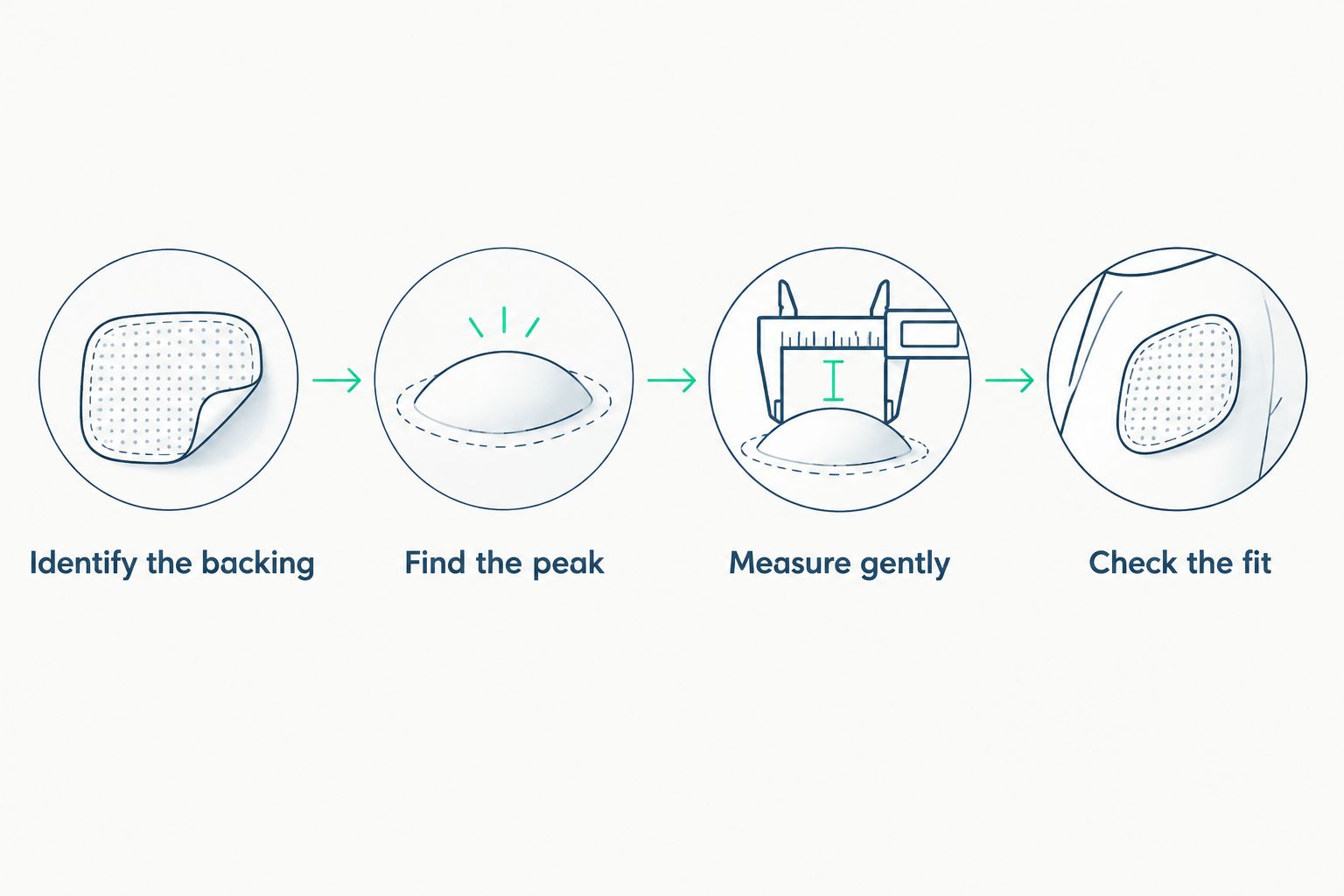
- Identify the backing. Decide whether you are measuring the patch alone or the complete attachment stack. State that choice alongside the result.
- Find the peak. Look across the face from the side and identify the highest raised detail. Do not automatically choose the border.
- Measure gently. Bring the caliper jaws into contact without squeezing the patch into a thinner reading. Keep the jaws aligned across the depth.
- Check the fit. Attach the patch to the intended panel and inspect the edges, nearby closures, and anything that passes across it.
Record what you measured, not just the result. “Maximum thickness including hook backing” tells another person something useful; an unexplained measurement leaves them guessing what was between the jaws.
If the patch came with a separate loop piece, distinguish that loose piece from the hook backing attached to the patch. Include the separate piece only when it belongs in the setup you are checking.
What to ask before buying
Ask: “What is the maximum finished thickness in millimeters, including the attached backing and highest raised detail?” That wording separates the number you need from width, height, and general material descriptions.
If you need clearance under a flap, say so. Ask whether the measurement includes any separate mounting material, and request a side-view measurement if the distinction remains unclear. A direct question beats conducting forensic analysis on a product thumbnail.
Why PVC patch thickness varies
Thickness depends on the construction and on exactly where you measure. Keep these factors separate when comparing specifications:
- Body depth: The molded PVC body contributes to the distance between the backing and the face.
- Raised relief: Lettering, borders, and artwork create local high points. The tallest feature determines maximum thickness.
- Backing: Attached hook material contributes to the finished patch depth. A body-only measurement excludes it.
- Mounting stack: A separate loop piece or mounting adapter changes the complete installed setup, even though it is not part of the PVC body.
- Measurement pressure: Squeezing a flexible patch changes its shape. Measure with contact rather than compression.
These factors explain why two measurements can disagree without either person measuring the same thing incorrectly. Before blaming the ruler, check the endpoints.
Compare like with like: maximum finished thickness against maximum finished thickness, with the same backing convention. Keep body-only measurements in their own comparison.
Is a thicker PVC patch better?
A thicker PVC patch is not automatically better; the right profile depends on where you attach it. Raised artwork gives a design physical depth, but extra projection is not a benefit everywhere.
For an exposed display panel, relief can be part of the appeal. For gear that slides through tight spaces or sits against other equipment, check whether that profile gets in the way. The patch should supply the attitude, not become another equipment problem.
Stickthison PVC morale patches are best for range-goers who want parody designs on their gear. When you need an exact low-profile fit, confirm the individual patch's finished thickness rather than choosing by the joke alone.
That is the honest trade-off: design appeal and dimensional suitability are separate decisions. You can love the artwork and still decide its shape is wrong for a particular panel. Move it somewhere better; the range bag will survive the rejection.
Will a thick PVC patch fit on a hat?
Hat fit depends on the panel's curve, the patch's footprint, and how its edges sit—not thickness alone. A depth measurement does not tell you whether a particular patch follows a particular hat.
Before you commit to a 2026 hat setup, position the patch on the panel and inspect it from the side. Check whether the center attaches while the edges stand away, whether the patch extends past the loop area, and whether you like how it feels when worn.
A hat rewards a different fit check than a flat display board. Choose the design you like, then judge it on the actual curve instead of assuming every hook-backed rectangle belongs on your forehead.
Does hook-and-loop backing count toward thickness?
Hook-and-loop backing counts when you are measuring finished thickness or installed projection. Excluding it gives you a material measurement, not the complete depth of the patch you are attaching.
Be precise about the separate loop piece, too. A patch attached directly to an existing loop panel has a different mounting stack from a patch installed with an additional adapter. Describe the actual arrangement rather than calling every layer “the backing.”
If attachment is the bigger question, the guide to hook-and-loop versus sew-on morale patches addresses that separate choice. Thickness alone does not decide the attachment method.
FAQ
How thick are PVC patches in millimeters?
PVC patches do not share one universal thickness in millimeters. Check the individual patch's maximum finished measurement, including its attached backing and highest raised detail.
Does 3D mean a PVC patch is 3 millimeters thick?
No, 3D describes raised artwork rather than a 3-millimeter thickness specification. You still need a separate depth measurement.
Is a 3 by 2-inch patch measurement its thickness?
No, 3 by 2 inches describes the patch's face dimensions. It tells you its width and height, not how far it projects from your gear.
Should I include the backing when measuring a morale patch?
Include the attached backing when measuring finished patch thickness. If you also include a separate loop piece or mounting adapter, identify that additional layer in the measurement.
Can I measure PVC patch thickness with a ruler?
A ruler is less useful than calipers for reading a small edge thickness. Use calipers with light contact and measure from the back to the highest raised detail.
Are thicker morale patches always more durable?
Thickness alone does not establish a morale patch's durability. Material, construction, attachment, and use also matter, so do not treat extra depth as a service-life guarantee.
How do I know whether a PVC patch will fit my range bag?
Check the patch's face dimensions against the loop panel, then inspect its installed profile near zippers, flaps, and handles. A patch can fit the panel's outline while still interfering with something beside it.
One last thing
The tallest point and the outer edge are not necessarily the same height. If you measure only the border, you can miss a raised feature in the middle—the exact feature that matters when something passes over the patch.
For your next 2026 patch purchase, save the artwork you like and ask for the measurement your setup actually needs. Width for panel coverage, finished thickness for clearance, and an installed check for the final verdict. Buy the joke; measure the fit.


Comments