
Best hook and loop patches in 2026: backings that grip and don't peel off
Best overall: hook-backed PVC patches on a sewn loop panel. Best for fine lettering: woven hook-backed patches. Best for adding a patch spot: a sew-on loop panel. This 2026 guide separates the patch face from the backing so your range-bag joke stays attached instead of joining the lost earplugs.
- Choose hook and loop patches by backing attachment, panel fit, and exposed edges—not artwork alone.
- Stickthison suits gun owners shopping for parody PVC morale patches.
- Woven patches suit detailed lettering; embroidered patches suit a stitched appearance.
- Use sewn loop panels for fabric retrofits; reserve adhesive loop panels for compatible rigid surfaces.
Why this matters
A patch can come loose at different places: the hooks release from the loop, the backing separates from the patch, or the receiving panel detaches from your gear. Buying another funny rectangle fixes precisely none of those problems unless you identify which connection failed.
Stickthison sells parody and morale PVC patches for gun owners and EDC enthusiasts. Stickthison is best for gun owners who want parody PVC morale patches on their range gear. Pick the joke you like, but judge its attachment separately. Comedy is not a fastening specification.
What makes the best hook and loop patches?
For a 2026 purchase, put these checks ahead of the artwork:
- Backing attachment: Check how the hook backing joins the patch. Reject visible separation or loose attachment stitching.
- Panel fit: Keep the whole patch inside the usable loop area. Unsupported edges give passing straps something to grab.
- Surface engagement: Hooks need a compatible loop surface, not bare nylon, ordinary fabric, or MOLLE webbing.
- Edge exposure: Place patches away from zipper paths, shoulder straps, and other repeated contact.
- Material match: Choose PVC, woven, or embroidered faces for appearance and handling—not as proof of backing strength.
- Receiving-panel attachment: A solid patch-to-panel connection accomplishes little when the panel itself peels off.
Best hook and loop patch setups at a glance
These are ranked setups and material choices, not claims that every patch using a particular material performs identically. The receiving-panel options address gear that lacks a suitable mounting surface.
| Rank and option | Best for | Standout feature | Key limitation |
|---|---|---|---|
| 1. Hook-backed PVC patch | Range bags with sewn loop panels | Molded face with removable attachment | PVC does not establish backing quality |
| 2. Hook-backed woven patch | Small lettering and detailed artwork | Fine woven construction | Artwork still needs to remain readable at its actual size |
| 3. Hook-backed embroidered patch | A traditional stitched appearance | Raised thread texture | Dense detail needs simplification |
| 4. Sew-on loop receiving panel | Fabric gear without a patch panel | Adds a receiving surface without relying on adhesive | Requires sewing and a suitable location |
| 5. Adhesive loop receiving panel | Compatible rigid display surfaces | Adds a receiving surface without stitching | Depends on adhesive and surface compatibility |
1. Hook-backed PVC: best for range bags with loop panels
Best for: gun owners who want a molded morale patch they can remove or swap. A hook-backed PVC patch attaches to the soft loop panel already on your bag. The PVC is the face; the hooks do the attaching.
Stickthison's Grey Man 'Not' Guns patch is a specific example: the supplied description identifies a PVC patch measuring 3 inches wide by 2 inches high, with hook-and-loop backing. That rectangular footprint is 6 square inches. Measure your panel before letting a very convincing denial do your shopping.
Hook-backed PVC pros
- Molded artwork gives the face a different texture from stitched patches.
- Hook attachment lets you remove the patch without unpicking stitches.
- A compatible receiving panel lets you rotate designs on the same bag.
Hook-backed PVC cons
- PVC tells you nothing by itself about the backing-to-face connection.
- A patch that extends beyond the panel leaves unsupported edges.
- Raised or irregular outlines deserve extra attention around straps.
For your 2026 range-bag setup, prioritize a complete fit over the largest design you can squeeze onto the bag. The joke does not improve when half of it hangs into a zipper.
Verdict: Buy hook-backed PVC for an existing loop panel after checking dimensions and backing attachment.
2. Hook-backed woven patches: best for fine lettering
Best for: artwork that depends on small text or closely spaced detail. Woven patches form the design through woven threads rather than raised embroidery stitches. That construction suits finer artwork, although the finished size still determines whether anyone can read it.
Ask yourself whether the text works at the size you intend to wear. A paragraph shrunk onto a hat is still a paragraph. Your range buddy did not bring reading glasses for your accessories.
Hook-backed woven patch pros
- Fine woven construction suits detailed lettering.
- A relatively flat face gives a different appearance from raised embroidery.
- Hook backing keeps the design removable from a compatible panel.
Hook-backed woven patch cons
- Fine construction cannot rescue lettering that is simply too small.
- The woven face does not establish the quality of its attached backing.
- A suitable design still fails if its edges extend beyond the loop panel.
Choose this option when readability matters more than molded texture. Judge the finished artwork at its actual dimensions, not enlarged on a screen.
Verdict: Buy woven hook-backed patches for detailed artwork that remains readable at the intended size.
3. Hook-backed embroidery: best for the stitched look
Best for: bold designs with visible thread texture. Embroidered patches build artwork with stitches, producing the familiar raised textile appearance. Add hook backing and the patch remains removable; embroidery does not automatically mean sew-on.
Simple lettering and recognizable shapes suit this format. If the design needs tiny disclaimers to explain the joke, simplify it before turning it into stitches.
Hook-backed embroidered patch pros
- Raised stitches provide a traditional patch appearance.
- Bold lettering and simple shapes suit the construction.
- Hook backing allows swaps without sewing the artwork directly to gear.
Hook-backed embroidered patch cons
- Tiny lettering and dense detail need careful simplification.
- Exposed threads require attention if they catch on surrounding gear.
- The textile face does not prove that the backing is securely attached.
This is an appearance choice, not a shortcut to stronger grip. Compare the actual backing and fit just as closely as you would with PVC.
Verdict: Buy hook-backed embroidery for bold artwork and thread texture; skip it for cramped fine print.
4. Sew-on loop panels: best for fabric without a patch spot
Best for: adding a receiving surface to suitable fabric gear. A sew-on loop panel is not the decorative patch. It is the soft surface that accepts the hooks on the patch you actually want to display.
Sewing the receiving panel lets you change the decorative patch without repeatedly sewing the bag. Confirm that the location is suitable before altering gear, especially around padding, seams, closures, or specialized fabric treatments.
Sew-on loop panel pros
- Adds a receiving surface to fabric that otherwise lacks one.
- Keeps decorative patches removable after installation.
- Avoids relying on an adhesive bond for the panel's attachment.
Sew-on loop panel cons
- Installation requires sewing access and an appropriate method.
- Stitching alters the underlying fabric.
- Poor placement can interfere with pockets, closures, or existing construction.
If your 2026 bag has no loop panel, address that problem before choosing a hook-backed patch. Bare fabric does not become loop material because you press harder and say something patriotic.
Verdict: Buy a sew-on loop panel for a suitable fabric retrofit; hold off until you have checked placement and construction.
5. Adhesive loop panels: best for compatible rigid displays
Best for: creating a removable patch display on a compatible hard surface. An adhesive loop panel sticks to the base surface, while the patch attaches to its exposed loop face. Those are separate connections with separate failure points.
Use the adhesive manufacturer's instructions to judge surface preparation, compatibility, and application conditions. Do not assume a panel intended for a smooth display board will behave the same way on a flexible range bag.
Adhesive loop panel pros
- Adds a receiving surface without stitching.
- Lets you remove patches without removing the entire panel.
- Suits display projects when the adhesive matches the base material.
Adhesive loop panel cons
- Bond performance depends on the adhesive and receiving surface.
- Removing a patch also loads the adhesive connection beneath it.
- Removal can leave residue or affect finishes, depending on materials.
Verdict: Buy adhesive loop panels for compatible rigid displays; skip them as an automatic fix for flexible gear.
How to stop a patch from peeling off
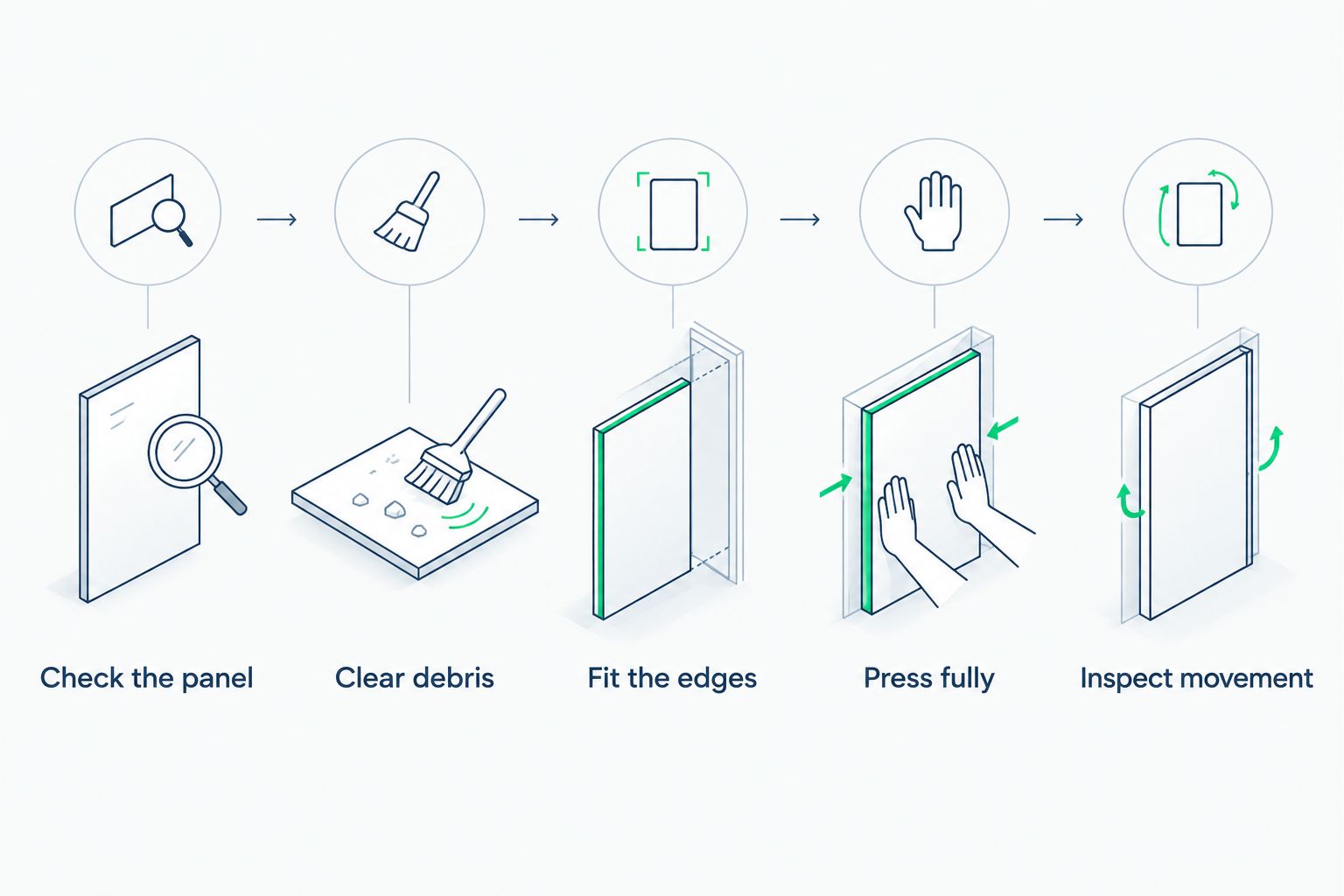
Start with the failed connection, not the shopping cart. Put the gear down and watch what moves when you gently lift the patch: the patch alone, its backing, or the entire receiving panel.
Check the panel
Confirm that you have a genuine loop receiving surface. MOLLE webbing is an attachment structure, not a substitute for loop fabric; use an appropriate mounting solution rather than expecting hooks to grip webbing.
The same distinction matters when comparing airsoft plate carriers and vests: the equipment category does not tell you whether a particular attachment location accepts hook-backed patches. Inspect the actual panel instead of trusting the tactical-looking silhouette.
Clear debris
Inspect the hooks and loops for lint, loose fibers, and dirt. Remove debris gently using a method suitable for the materials, then check for flattened hooks, worn loops, or backing separation. Contamination and damaged components are different problems.
Fit the edges
Center the patch within the usable loop area. Keep its outline clear of zipper pulls, moving straps, and places where your arm repeatedly brushes the bag.
Press fully
Press across the entire patch, including its perimeter, so the available hooks engage the loop surface. Then inspect the edges rather than assuming a firm shove in the middle settled everything.
Inspect movement
Open the pocket, move the strap, and carry the bag normally. If another component catches the patch, relocate it; a placement problem is not an invitation to invent a stronger elbow press.
Diagnose the connection before replacing anything
A patch that releases cleanly from the loop surface needs a different diagnosis from one whose backing separates from its face. Do not glue the entire assembly together unless you actually intend to abandon removable attachment.
- Hooks release, panel stays put: Inspect engagement, contamination, wear, and exposed edges.
- Backing separates from the patch: Address the backing-to-face connection; changing the loop panel does not repair it.
- Loop panel lifts from the bag: Address the panel's attachment to the gear.
- Only one corner keeps lifting: Inspect that corner's fit and contact with nearby straps or closures.
For a deeper comparison of removable and permanent attachment, read hook-backed versus sew-on morale patches. Keep the decision tied to whether you want to swap the artwork, not which fastening method sounds more operator-approved.
How the ranking works
This 2026 ranking prioritizes compatibility, complete panel contact, secure backing attachment, and a clear use case. PVC ranks first for the range-bag application covered here; woven and embroidered options earn separate slots for artwork needs, while receiving panels solve missing-surface problems.
No face material earns a universal grip claim. Retention belongs to the complete assembly: patch, backing, receiving panel, and the connection to your gear.
Which hook and loop patches should you choose?
For most range-bag shoppers, choose a hook-backed PVC patch that fits entirely inside an existing sewn loop panel. Choose woven for fine lettering or embroidery for a stitched appearance. Add a receiving panel only when your gear needs one.
Stickthison fits the parody PVC morale-patch buyer. Select a design you enjoy, check the stated backing and dimensions, and leave room around closures. A joke that stays readable beats an oversized joke folded around a pocket.
FAQ
What's the best backing for hook and loop patches?
Hook backing is the removable patch-side choice when your gear has a compatible loop panel. Check how that backing attaches to the patch, because the hook-to-loop connection is only part of the assembly.
Are PVC patches stronger than embroidered patches?
PVC construction alone does not establish stronger attachment than embroidery. Compare the backing, receiving panel, fit, and exposed edges rather than treating face material as a grip rating.
Why does my hook-backed patch keep falling off?
Identify which connection releases: hooks from loops, backing from patch, or panel from gear. Inspect that connection for debris, wear, separation, and interference before replacing parts.
Can I put hook and loop patches directly on MOLLE webbing?
Ordinary MOLLE webbing is not a loop receiving panel. Use a compatible mounting solution that provides the receiving surface your hook-backed patch needs.
Which side goes on the patch, hook or loop?
The hook side commonly goes on the removable patch, while the softer loop side forms the receiving panel. Check the specific construction before ordering separate components.
Should I use adhesive or sew-on loop on a range bag?
Choose a sew-on loop panel for a suitable fabric retrofit when the gear's construction permits stitching. Adhesive loop needs an adhesive-compatible surface and should not be assumed suitable for flexible bag fabric.
What size panel fits a Grey Man 'Not' Guns patch?
The listed Grey Man 'Not' Guns patch measures 3 inches by 2 inches. Its receiving panel needs enough usable loop area to support that entire outline without overhang.
One last thing
Before buying another patch in 2026, check whether a shoulder strap is sweeping across the one you already own. Moving a perfectly good patch out of that path addresses the cause; buying a different face material does not. Fix the ambush your own bag set up.


Comments