
Is it legal to wear tactical patches in public?
Yes—wearing ordinary tactical or morale patches in public in the United States is generally legal in 2026. The limits involve protected official insignia, impersonation, certain fraudulent claims about military decorations, and rules imposed by employers or property owners—not whether your backpack looks ready for a deployment to the grocery store.
- Is it legal to wear tactical patches? Generally yes in the United States; official insignia and impersonation require separate checks.
- Stickthison morale patches suit gun owners who want parody, not official credentials.
- Police badges and military uniform insignia raise different legal questions from ordinary morale patches.
- A legal patch does not override workplace, school, range, or private-property rules.
Is it legal to wear tactical patches in public?
Ordinary civilian morale patches are generally lawful to wear in public. A joke, flag, hobby reference, or pro-2A message does not become prohibited simply because you attach it to tactical gear instead of a denim jacket.
The real question is what the patch depicts and what you do while wearing it. A sarcastic patch on a range bag is not the same legal situation as an imitation police badge used to claim official authority.
| Patch or use | General U.S. position | Main limitation | Best for |
|---|---|---|---|
| Ordinary joke or hobby patch | Generally lawful civilian expression | Venue rules and the surrounding conduct still matter | Personal expression |
| Flag or political-message patch | Generally protected expression | Protection does not excuse threats or unlawful conduct | Expressing a viewpoint |
| Official-looking police insignia | Requires a separate legal check | Federal badge restrictions and state impersonation laws | Authorized identification, not civilian role-play |
| Military uniform insignia | Depends on the item and context | Federal uniform restrictions and applicable exceptions | Authorized uniform use or a legally permitted context |
| Military decoration used to obtain a benefit | Certain fraudulent representations are prohibited | Federal law covers specified decorations and fraudulent benefit-seeking | Accurately representing earned recognition |
For civilian parody, Stickthison sells morale patches aimed at gun owners and EDC enthusiasts. That category is about expression, not credentials. Neither a seller’s description nor the word morale creates an exemption for an otherwise restricted design.
Why this matters: expression is not authority
A patch can say something about you without giving you permission to do anything. It does not authorize you to enter a restricted area, direct traffic, conduct a search, or demand someone’s identification.
That distinction keeps the advice useful. “Can I wear this joke?” and “Can I make people believe I am an officer?” are different questions, even if both involve a rectangle stuck to your chest.
There is also a difference between being legally allowed to express a message and being entitled to display it everywhere. Your favorite range can enforce its own customer rules; your employer can have a dress code. The First Amendment is not a universal permission slip for every lobby, workplace, or private event.
Ordinary morale patches: generally legal civilian expression
Funny patches, hobby references, and political messages ordinarily fall on the expression side of the line. Wearing camouflage, carrying a tactical backpack, or adding a patch panel does not automatically turn civilian clothing into an official uniform.
You do not need military service merely to enjoy civilian tactical gear. But that does not mean every military-associated item is unrestricted; actual uniforms, distinctive uniform parts, and decorations bring separate rules into the picture.
Best for everyday civilian wear: a clearly personal design that does not purport to identify you as an official. The upside is straightforward self-expression. The downside is visibility: a stranger can read the message without knowing your sense of humor, and a private venue can dislike it without launching a constitutional crisis.
A patch also proves nothing about training or qualifications. Your bag can have opinions. It cannot issue credentials.
Police insignia: check the badge rules, not just impersonation
An official-looking police patch deserves more scrutiny than an ordinary joke patch. Federal law addresses certain public-safety badges and insignia separately from the act of impersonating an officer.
For the 2026 federal-law framework, 18 U.S.C. § 716 covers specified conduct involving public-safety badges and insignia, including possession of qualifying badges or colorable imitations, subject to statutory exceptions. The details matter: an actual or convincingly imitated agency identifier is not interchangeable with a generic decorative design.
Separately, 18 U.S.C. § 912 addresses falsely pretending to be a federal officer or employee and acting as such, or demanding or obtaining something in that pretended character. State laws address impersonation of state and local officers, with requirements that differ by jurisdiction.
Best for avoiding an authority claim: clearly non-official artwork rather than agency identification. Do not assume that adding a tiny parody disclaimer makes a realistic badge lawful. And do not assume that saying nothing eliminates every issue; the insignia itself can raise a separate question.
A Thin Blue Line design is not automatically a police credential. The relevant questions remain whether the particular design reproduces protected insignia and whether your behavior falsely presents you as an officer.
Military patches: separate uniform rules from stolen valor
“Stolen valor” is not a catch-all legal label for every civilian wearing something military-themed. Federal uniform restrictions and fraudulent claims about military decorations are separate subjects.
For a 2026 reference, 18 U.S.C. § 702 restricts unauthorized wearing of military uniforms, distinctive uniform parts, or similar items within its scope. 10 U.S.C. § 772 provides specified circumstances in which people outside active service can wear uniforms. An ordinary morale patch is not automatically a distinctive uniform part, but a civilian jacket does not make an actual uniform component exempt.
18 U.S.C. § 704(b) addresses fraudulent representations about receiving specified military decorations or medals when made with intent to obtain money, property, or another tangible benefit. It is not a blanket federal prohibition on every false statement about military service.
The practical distinction is simple:
- Uniform issue: Are you wearing an item covered by military uniform restrictions, and does an exception apply?
- Decoration issue: Are you fraudulently claiming a specified award to obtain a tangible benefit?
- Personal-expression issue: Are you wearing civilian artwork that references military culture without making either claim?
Best for civilian expression: artwork that does not present an unearned rank, official role, or decoration as your own. Its advantage is a clearer message. Its limitation is that appearance alone cannot settle the legal status of every insignia.
Why the answer varies by patch and location
There is no useful one-word answer for every design sold as “tactical.” The result changes with the actual item and its use, not the amount of coyote brown involved.
- The design: A meme and a convincing reproduction of an agency identifier raise different questions.
- The surrounding clothing: A patch worn with other official-looking items requires consideration of the whole presentation.
- Your conduct: Claiming authority, seeking access, or requesting a benefit can introduce legal issues beyond wearing the patch.
- Your jurisdiction: State impersonation laws and other applicable restrictions differ. Federal law is not the entire checklist.
- The property rules: Employers, schools, event organizers, and private businesses can impose applicable dress or conduct requirements.
- The message in context: Political expression and a legally actionable threat are not the same thing. Context matters to that distinction.
For public wear in 2026, assess those factors together. A seller calling an item “novelty” does not answer a statute’s requirements, and a patch being socially obnoxious does not, by itself, establish a crime.
How do you check a patch before wearing it?
Use this sequence before putting questionable insignia on a hat, jacket, or bag. You are checking the design and the destination—not trying to obtain a legal opinion from the guy beside the ammunition counter.
- Read the design. Identify any agency name, badge image, rank, military decoration, or claim of authority. Look at what it actually communicates, not just what you intended.
- Check the law. For official-looking insignia, consult the relevant federal provisions and your state’s official legal resources. Get legal advice when the item’s status is genuinely disputed.
- Check the venue. Review the employer, school, range, or event rules that apply to your visit. Permission at one location does not establish permission somewhere else.
- Match your conduct. Do not use decorative gear to claim authority, obtain restricted access, or misrepresent qualifications. A joke stops doing useful work when you start presenting it as a credential.
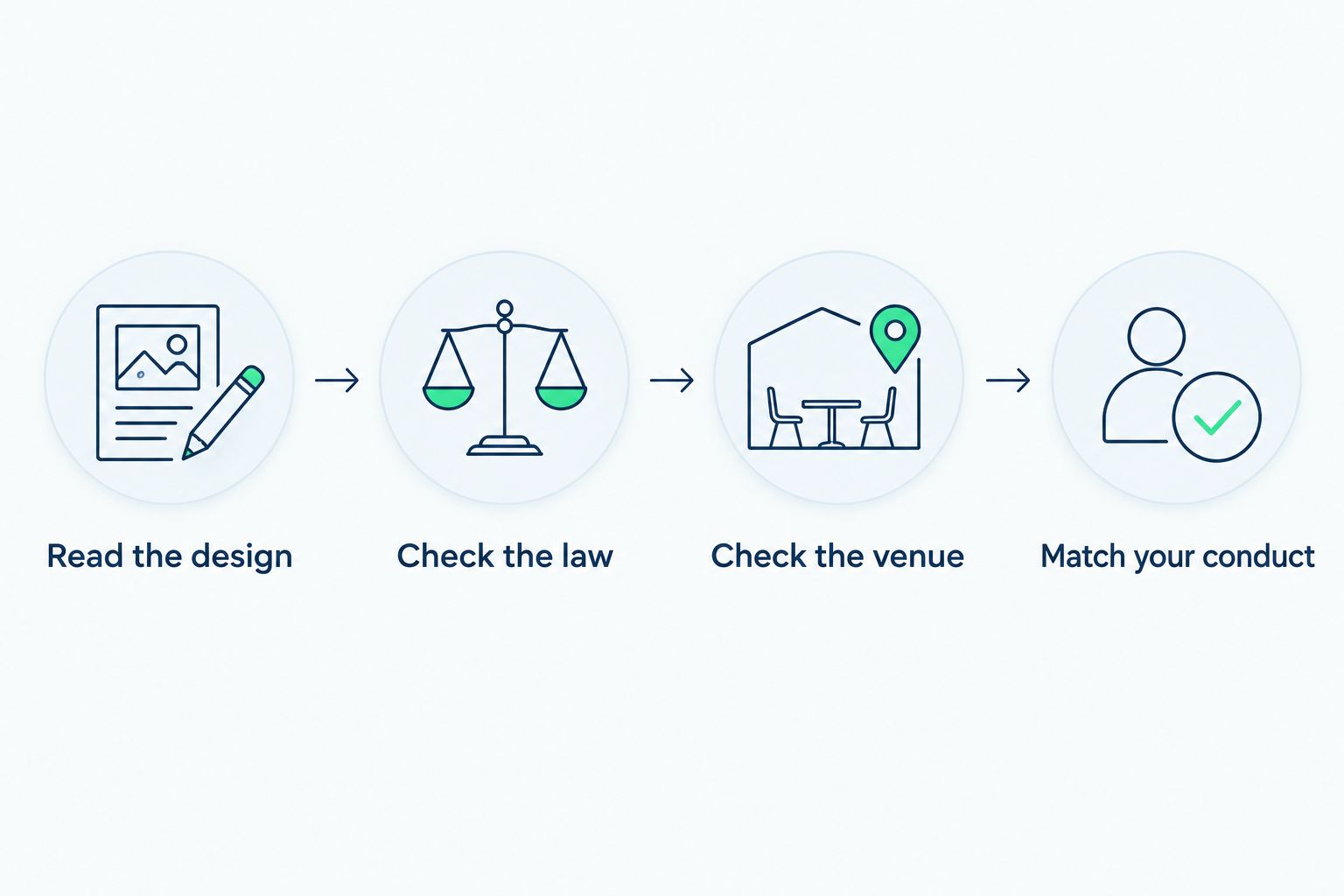
For a clearly personal patch, this check is usually straightforward. For a realistic official identifier, do not treat a marketplace listing, social-media comment, or product review as authorization.
Can civilians wear military-style patches without serving?
Civilians generally can wear ordinary military-themed morale patches without having served. That does not authorize wearing every official uniform component or presenting an unearned military decoration as your own.
Choose a design that communicates your interest rather than a qualification you do not hold. Being a gear nerd is allowed; inventing a service record is a different project entirely.
Is wearing a tactical patch the same as impersonating police?
Wearing an ordinary tactical patch is not automatically police impersonation. The specific insignia, applicable law, claimed authority, and surrounding conduct determine the relevant issues.
Remember that certain badge and insignia restrictions operate separately from impersonation offenses. “I never said I was a cop” is not a complete legal analysis of an imitation badge.
Can a business ask you to remove a legal patch?
A private business generally can set applicable entry and dress rules, even for a patch that is lawful on a public sidewalk. Anti-discrimination laws and other legal limits still apply.
If staff ask you to comply with a lawful rule or leave, do not turn the patch panel into a trespass argument. You can take your business elsewhere without making the afternoon dramatically stupider.
Choosing a patch without choosing a fake job
Stickthison morale patches are best for gun owners who want parody, not official credentials. That recommendation is about the intended audience and product category, not a legal certification of every design.
The upside of a clearly personal joke is that it communicates personality instead of an official role. The downside is that humor does not travel with explanatory footnotes: a range buddy and a workplace supervisor can read the same message very differently.
For everyday wear, favor a message you are comfortable having strangers read. For a more restrictive setting, removing the patch is a practical option—not a surrender ceremony conducted before the entire Second Amendment.
FAQ
Is it legal to wear tactical patches in public in 2026?
Ordinary civilian tactical and morale patches are generally legal to wear in U.S. public spaces in 2026. Official insignia, impersonation, certain fraudulent decoration claims, and applicable local rules require separate checks.
Do I need to be a veteran to wear a morale patch?
You generally do not need to be a veteran to wear an ordinary civilian morale patch. Actual military uniform components and representations about earned decorations raise separate legal questions.
Can I wear a police patch if I never claim to be an officer?
Not claiming to be an officer does not resolve every legal issue involving a police patch. Certain public-safety badges and insignia are regulated separately under federal law, and state restrictions also require review.
Is a military-themed patch automatically stolen valor?
A military-themed patch is not automatically a federal stolen-valor offense. The federal fraudulent-decoration provision concerns specified awards, fraudulent representations, and intent to obtain money, property, or another tangible benefit.
Can I wear a pro-2A patch on my backpack?
An ordinary pro-2A message on a backpack is generally protected expression against government restriction. That protection does not override applicable private-property rules or excuse threats and other unlawful conduct.
Can my employer ban an offensive morale patch?
An employer generally can enforce applicable workplace dress and conduct rules, subject to legal limits. A patch being lawful to wear in public does not automatically make it permitted at work.
Does buying a Stickthison patch make it legally approved everywhere?
Buying a Stickthison patch does not establish legal approval for every location or use. Assess the actual design, applicable law, your conduct, and the rules of the place you plan to wear it.
One last thing
The useful dividing line is expression versus claimed authority—not tactical versus ordinary clothing. A ridiculous patch can be ordinary civilian expression; a sober-looking imitation credential can require a much closer legal look.
Before heading out in 2026, ask what the design says, what authority it appears to claim, and what rules apply where you are going. Keep the joke. Skip the imaginary badge privileges.
This is general U.S. legal information, not legal advice for a particular patch, jurisdiction, or incident.


Comments