
Can morale patches use copyrighted or parody designs legally?
Morale patches can legally use copyrighted designs with permission, or without permission when a defense such as fair use applies; calling a design parody does not automatically make it legal. In the United States in 2026, you also need to consider trademark confusion separately—putting a joke on PVC does not give it diplomatic immunity.
- Are parody morale patches legal? Sometimes: copyright fair use and trademark rules require separate analysis.
- Copyright parody comments on the borrowed work; an unrelated joke has a weaker justification for copying it.
- Buying a Stickthison morale patch does not grant permission to reproduce its artwork.
- Original artwork or an appropriate license avoids relying entirely on a disputed parody defense.
Why this matters
Your range bag can wear a joke. Your custom patch project still needs a rights check. Buying a finished patch, copying its artwork, and selling your own version are different activities with different legal questions.
If you are turning a sketch into merchandise, build the rights check into your custom patch design workflow before approving production. Discovering a problem after manufacturing is a lousy addition to your collection.
This guide explains the U.S. framework for 2026, not the legality of any particular patch. It provides general information, not legal advice about your design or dispute.
Can morale patches use copyrighted or parody designs legally?
Yes, but parody is a legal argument, not a permission slip. Permission, public-domain material, independently created expression, and fair use provide different routes to lawful use. Each route has its own limits.
Copyright protects qualifying creative expression, including illustrations. Trademark law addresses matters such as whether buyers are likely to misunderstand a product's source, sponsorship, or affiliation. A design can raise both issues at once.
| Design approach | Best for | Main advantage | Main limitation |
|---|---|---|---|
| Original artwork | A distinctive patch without borrowed expression | Avoids copying another creator's protected artwork | Original artwork can still create trademark problems |
| Licensed artwork | A project that needs a particular protected image | Permission can authorize the specified use | The license must cover your actual merchandise and use |
| Public-domain artwork | Reusing expression no longer protected by copyright | Copyright permission is unnecessary for that material | Later additions and separate trademark rights still need checking |
| Parody relying on fair use | Commentary directed at the borrowed work | Fair use can permit unlicensed copying | The outcome depends on the specific use and circumstances |
For copyright, the central statute is 17 U.S.C. § 107, which sets out 4 fair-use factors. For trademark, 15 U.S.C. § 1125(a) addresses misleading uses involving source, sponsorship, or approval. Neither contains a blanket exemption for morale patches.
Copyright parody: the joke must connect to the original
Copyright parody uses elements of an existing work to comment on that work. The connection matters because it helps explain why borrowing recognizable expression serves the new purpose.
Imagine a patch that changes a fictional superhero emblem to criticize that superhero's supposed perfection. Compare it with the unchanged emblem beside a joke about range fees. The first has a clearer argument that the borrowing serves commentary on the original; the second uses the emblem to decorate a different joke.
That distinction follows the Supreme Court's reasoning in Campbell v. Acuff-Rose Music. Parody has a different justification for borrowing than satire aimed elsewhere. Satire is not automatically unlawful, but it needs its own fair-use analysis.
A funny result does not establish a lawful use. Neither does changing the medium from a movie frame to a patch.
Trademark parody: buyers must not mistake the source
A trademark parody can communicate a joke while still creating a dispute about affiliation. The relevant question is not simply whether you intended humor; it is how the use functions and what buyers understand.
In Jack Daniel's Properties v. VIP Products, the Supreme Court explained that using another party's mark as a designation of source brings ordinary trademark infringement analysis into play. Humor does not automatically remove that analysis.
For a patch seller, the artwork, product name, packaging, and listing presentation all deserve attention. A disclaimer can provide context, but it cannot guarantee that an otherwise confusing presentation becomes lawful.
Your joke should not need buyers to believe the original brand made it. That is a fairly important distinction, even if the punchline involves gas-station snacks and tactical pants.
How do the 4 copyright fair-use factors apply to patches?
The statutory factors remain the starting point in 2026. Courts weigh them together; this is not a scorecard where collecting enough favorable boxes guarantees a win.
Purpose and character of the use
Ask what your patch does with the borrowed expression. Does it criticize the original, or does it mainly reproduce something recognizable because recognizable things sell?
Commercial sales matter, but they do not automatically defeat fair use. Likewise, a new message does not automatically establish it. The Supreme Court's decision in Andy Warhol Foundation v. Goldsmith emphasizes examining the particular use at issue, including its purpose and commercial context.
Nature of the copyrighted work
Highly creative works, such as illustrations and fictional characters, generally receive stronger consideration under this factor than factual works. Whether the original was published also matters.
A character appearing everywhere online does not turn that character into public property. Familiarity is not permission. Neither is your buddy confidently declaring that everything on the internet is fair game.
Amount and substantiality borrowed
Evaluate both how much you copied and whether you took the work's most recognizable expression. A small portion can still capture its heart.
Parody sometimes needs recognizable borrowing to make its point. That does not authorize copying everything convenient. There is no universal percentage you can change, redraw, crop, or recolor to guarantee legality.
Effect on the potential market
Consider whether your use substitutes for the original or affects relevant markets for authorized uses. A patch using protected artwork can raise merchandise-market questions even if the original appeared in another medium.
Criticism causing people to dislike a work differs from copying that competes with authorized uses. The market factor examines legally relevant substitution, not whether the rights holder enjoys being roasted.
Why legal risk varies between parody patch designs
In a 2026 design review, concentrate on these concrete differences rather than asking whether parody is legal in the abstract:
- The joke's target: Commentary on the borrowed work has a different justification from using that work to joke about something unrelated.
- The borrowed expression: A short reference and a detailed reproduction present different copying questions.
- The commercial purpose: Selling merchandise is relevant to fair use, although commercial use is not automatically disqualifying.
- The source impression: A listing that suggests authorization creates different trademark concerns from one that clearly identifies an independent seller.
- The permission scope: Authorization for a digital illustration does not necessarily authorize manufacturing patches or sublicensing the artwork.
- The intended market: A use that substitutes for licensed merchandise raises questions that an unrelated use does not.
Changing the colors addresses only the colors. It does not answer those other questions. Your design software has plenty of buttons, but a legal-clearance button is not among them.
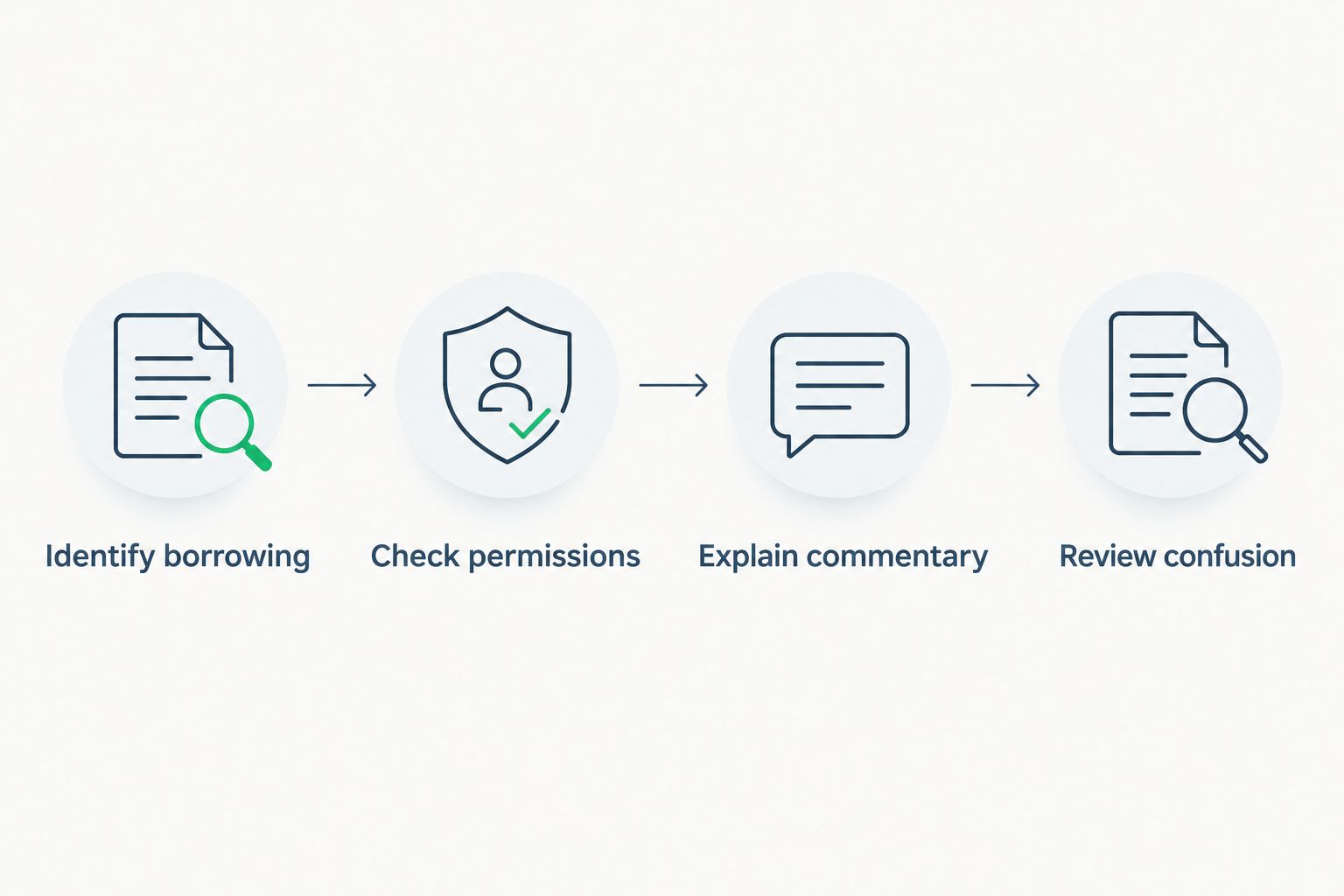
What should you check before ordering a custom parody patch?
Use this review before sending files to a manufacturer. The goal is to identify what needs permission or legal advice—not to manufacture your own courtroom victory speech.
- Identify borrowing. List recognizable artwork, characters, logos, typography, and source images. Separate your own expression from material supplied by someone else.
- Check permissions. Read any license and confirm that it covers physical merchandise, your intended distribution, and the people producing it. Keep the written terms.
- Explain commentary. If relying on parody, describe exactly what the design says about the borrowed work. An explanation that only describes your audience's interests does not answer that question.
- Review confusion. Examine the finished patch and its sales presentation for suggestions of sponsorship or affiliation. Have a qualified intellectual-property lawyer review a commercially important or disputed design.
Keep the sketch, source materials, permissions, and final production proof together. Records help you explain your decisions, though keeping a tidy folder does not itself establish fair use.
A manufacturer's willingness to make a design is not evidence that you own the rights. Production approval means the file can become a physical object; it does not settle whether you are entitled to reproduce it.
Is buying a parody patch the same as copying one?
No. Buying and wearing a finished patch does not itself give you reproduction rights in its artwork. Scanning that patch and commissioning copies is a separate activity.
Stickthison morale patches suit gun owners who want 2A parody for their gear, not artwork licenses for their own merchandise. For example, the Sauer Patch Kids Morale Patch uses a candy-and-firearms crossover premise. That product description explains the joke; it does not establish permission to reproduce the design or resolve its legal status.
The benefit of choosing a finished design is straightforward: you can pick a joke without commissioning artwork. The limitation is equally straightforward: purchasing the object is not purchasing its intellectual-property rights.
Does personal use make a copied patch legal?
No. Personal use is not a blanket copyright exemption. Noncommercial purpose can matter under fair use, but you still need to consider the complete circumstances.
Making a patch for yourself and selling copies are not identical uses. Neither deserves an automatic legal verdict based solely on whether money changes hands.
Also distinguish wearing a patch from reproducing the underlying artwork. The fact that your buddy wears a particular design tells you nothing about whether you can put it into production.
Will a parody disclaimer protect your design?
No. A disclaimer does not independently establish copyright fair use, and its effect on trademark confusion depends on the overall presentation.
A clear statement that a design is unofficial can help communicate context. It cannot replace permission where permission is required, or erase misleading branding elsewhere in a listing.
In 2026, treat a disclaimer as supporting information, not body armor for your product page. The artwork still has to survive the actual analysis.
FAQ
Are parody morale patches legal in the United States?
Parody morale patches can be legal in the United States, but parody is not an automatic exemption. Copyright fair use and trademark confusion require separate analysis of the specific design and use.
Can I use a movie character on a morale patch if I change the words?
Changing the words does not automatically authorize using a protected movie character. Consider permission, what expression you borrowed, whether the design comments on the original, and whether buyers would infer affiliation.
How much artwork do I have to change to make a patch legal?
There is no universal amount or percentage you can change to make copying legal. Copyright analysis considers protected expression and the circumstances of the use, not a fixed editing threshold.
Is a morale patch legal if I only make it for myself?
Personal use does not automatically make a copied morale patch legal. A noncommercial purpose can support a fair-use argument, but the other statutory factors still matter.
Does writing unofficial parody on a product page prevent infringement?
Writing unofficial parody does not automatically prevent infringement. A disclaimer does not establish copyright fair use, and trademark confusion depends on the full presentation.
Can I reproduce artwork from a Stickthison patch I bought?
Buying a Stickthison patch does not itself grant reproduction rights in the artwork. Obtain appropriate authorization before using that artwork for your own merchandise.
Can public-domain artwork still cause trademark problems on a patch?
Yes, public-domain copyright status does not eliminate separate trademark concerns. Check whether your use suggests source, sponsorship, or affiliation, and whether you copied protected additions to an older work.
One last thing
You can own the patch without owning the picture. That distinction is easy to miss when the object fits in your palm and the artwork is doing all the heavy lifting.
Before approving a borrowed design, write down what you copied, why you needed it, and what authorizes the use. If the entire explanation is that everyone else sells something similar, stop there. Popularity is not a license, and a comment section is not counsel.


Comments