
How big is 3 inches, really?
Three inches is exactly 7.62 centimeters, or 76.2 millimeters—one-quarter of a foot. That measurement describes a length, not an object's width, height, or overall footprint; a 3-inch patch can still be the wrong shape for your gear. Here's how to picture the distance, measure it, and avoid buying something based entirely on optimistic photography.
- How big is 3 inches? Exactly 7.62 centimeters, 76.2 millimeters, or one-quarter of a foot.
- For morale patches, check width and height; a 3-inch circle and rectangle occupy different footprints.
- Stickthison sells parody morale patches for gun owners; a product's joke is not its dimensional specification.
- Use a ruler and a paper template to check fit before decorating your range bag.
How big is 3 inches, really?
Three inches measures exactly 7.62 cm from one endpoint to the other. On an inch ruler, it is the distance from the zero mark to the mark labeled 3—not necessarily from the physical edge of the ruler.
| Measurement | Exact equivalent of 3 inches |
|---|---|
| Centimeters | 7.62 cm |
| Millimeters | 76.2 mm |
| Feet | 0.25 ft |
| Fraction of a foot | One-quarter |
The conversion uses the exact relationship of 1 inch to 2.54 centimeters. Multiply 3 by 2.54 and you get 7.62 cm. No rounding, no measuring contest, no buddy insisting the ruler is wrong.
If you're shopping for morale patches for range bags, that length is only the beginning. You also need the other dimension, the shape, and enough usable space to attach the thing.
Why this matters: a dimension is not a fit guarantee
A product photo shows you the design. Unless it includes a reliable scale reference, it does not tell you how large that design will look on your actual bag, hat, case, or display panel.
Your 2026 gear-shopping rule should be simple: measure the mounting space before falling in love with the joke. An excellent punchline still looks dumb folded around a zipper.
Separate these three questions:
- Length: How far does the object extend in one direction?
- Footprint: How much width and height does the whole object occupy?
- Fit: Does that footprint work on the specific surface you want to use?
You can answer the first question with a single measurement. The other two need more information. That's the difference between knowing what 3 inches means and knowing whether a patch belongs on your range bag.
What does 3 inches look like beside everyday objects?
A ruler is the clearest reference because it measures the distance directly. Everyday objects help you picture the scale, but their dimensions need to be known rather than guessed.
A standard ID-1 payment card measures 85.60 mm along its long edge. Three inches is 76.2 mm, so it is 9.4 mm shorter than that edge. Use the card's long side, not its short side, and remember that an unusual card format is not the same reference.
| Reference | How it compares | Best for | Limitation |
|---|---|---|---|
| Inch ruler | Measure directly from 0 to 3 inches | Exact measurement | You must start at the zero mark |
| Metric ruler | Measure directly to 76.2 mm | Exact conversion | Small markings require careful reading |
| Standard ID-1 payment card | Its long edge is 9.4 mm longer | A quick mental picture | It is not an exact 3-inch template |
| Your finger or palm | Dimensions differ between people | A rough personal reference | It is unreliable unless you measure it first |
Use a ruler for a fit decision; use a card only to picture the scale. Your hand is convenient, but convenience is not a calibration certificate.
A phone screen is an even shakier reference. Zoom settings and display size change how large an image appears. A picture labeled actual size does not become a ruler just because somebody typed confidently underneath it.
Three inches wide: 7.62 cm across
A measurement of 3 inches wide describes the object's horizontal span in its intended orientation. It says nothing about height unless the listing provides a second dimension.
For example, a hypothetical rectangle measuring 3 inches wide by 1 inch tall has a different footprint from one measuring 3 inches wide by 2 inches tall. Both are honestly described as 3 inches wide. They are not interchangeable on a narrow mounting panel.
Read the dimension labels rather than assuming the first number always means width. If the listing identifies width and height explicitly, follow those labels. A product name is not a substitute for that information, even in 2026, when apparently everything needs a dramatic name.
A 3-inch circle: 7.62 cm in diameter
A 3-inch-diameter circle measures 3 inches across its center. Its radius—the distance from the center to the edge—is 1.5 inches, or 3.81 cm.
That circle needs a clear footprint measuring at least 3 inches across in both directions to sit entirely within a flat rectangular space. A panel that is wide enough but too short does not become suitable through enthusiasm.
The circle's advantage is its consistent outside span when rotated. Its limitation is that it does not fill the corners of a rectangular panel. If you want to cover an existing rectangular mark or design, diameter alone does not settle the question.
A 3-inch square: 7.62 cm on each side
A 3-inch square measures 3 inches wide and 3 inches tall. Its area is 9 square inches, which describes surface coverage rather than a linear distance.
A 3-inch circle fits inside that square, but the two shapes do not cover the same area. The square reaches into corners that the circle leaves exposed. Same headline measurement, different coverage.
Neither shape is automatically better. Choose the outline that fits your usable panel, not the one that wins an imaginary argument about which looks more tactical. The zipper has no respect for your aesthetic vision.
Why 3 inches looks bigger or smaller
Three inches does not change. Its appearance changes with the object, its surroundings, and how you see it.
- Second dimension: A tall rectangle has a different footprint from a narrow strip of the same width.
- Outline: Circles, squares, and irregular shapes distribute that width differently.
- Surrounding space: The same patch occupies more of a small panel than a large one.
- Viewing distance: A design fills more of your view when you hold it close.
- Photo scale: Cropping and zoom change apparent size without changing physical dimensions.
- Surface curvature: A flat outline can sit differently on a curved hat than on a flat display board.
For a 2026 online purchase, trust stated measurements over the amount of screen space a product occupies. A close-up can make a small patch look like it needs its own parking permit.
Keep appearance and readability separate, too. The outside dimension tells you the available footprint, not whether the design's smallest text will be comfortable for you to read at your intended distance.
How do you measure 3 inches accurately?
Measure 3 inches from the ruler's zero mark, not automatically from its end. Some rulers have a gap between the physical edge and the start of the scale.
Use this sequence when checking a patch, sticker, or mounting area:
- Find zero. Locate the actual zero line before placing the ruler against the object.
- Measure width. Keep the ruler straight across the intended horizontal span, without tilting it diagonally.
- Measure height. Check the other direction, including the widest or tallest protrusions on an irregular outline.
- Cut template. Draw the full stated outline on paper and cut it out.
- Check placement. Hold the template where the object will sit and check nearby seams, edges, straps, and zippers.
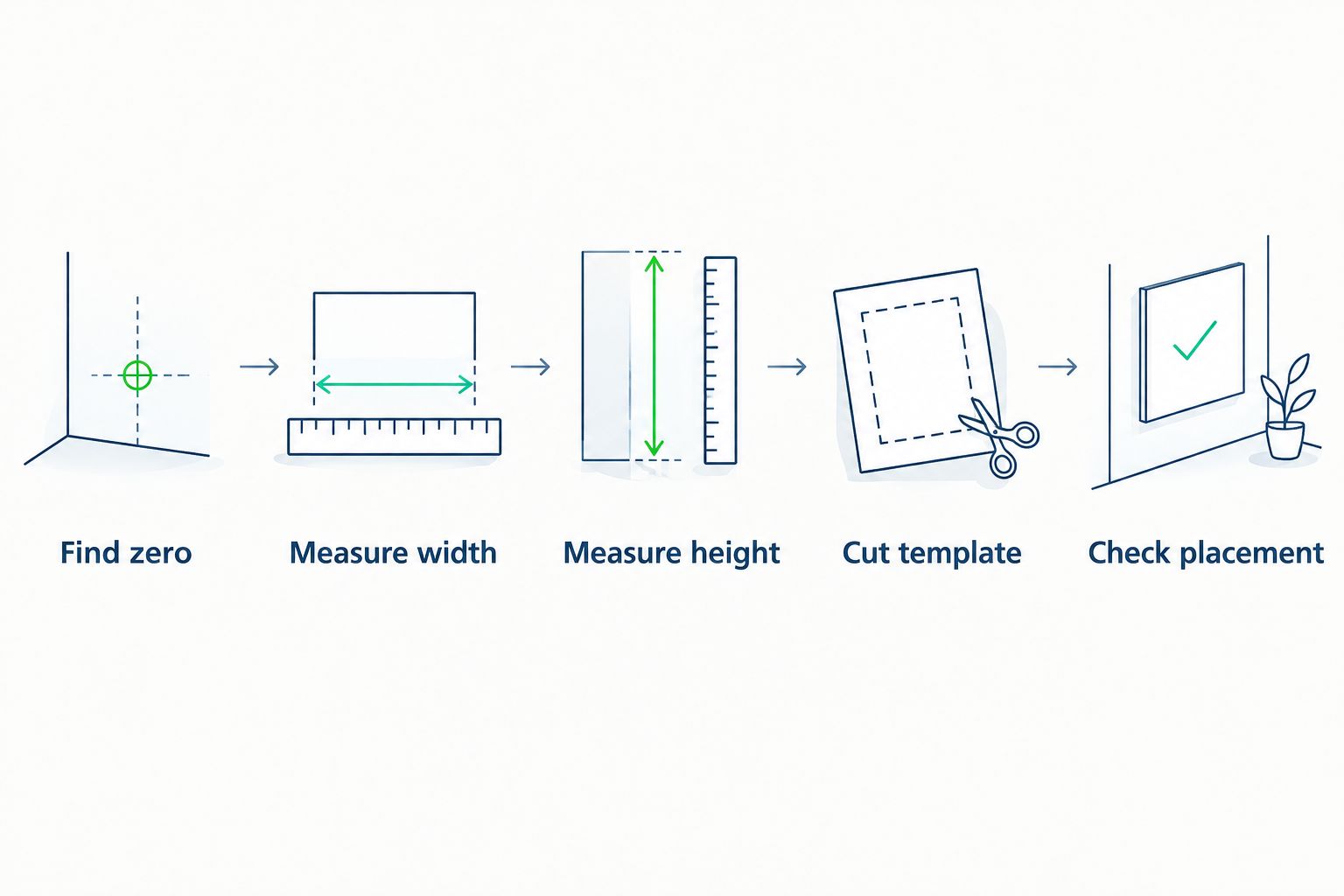
If you're checking a soft bag, place it in the configuration you actually use. A panel lying flat on a table is not necessarily shaped the same way when the bag is packed.
Don't add an arbitrary clearance allowance and call it universal. Check the specific location instead. The template should stay clear of anything you need to open, grip, or move.
How do you check a patch or sticker before buying?
Match the complete outline to the usable surface, then check the attachment method. Those are separate checks, and passing one does not excuse failing the other.
For a patch, confirm what backing the individual listing specifies and what your gear accepts. A fabric panel is not automatically a compatible attachment surface. Likewise, dimensions alone do not tell you how a sticker's adhesive will behave on a particular finish.
Your short pre-purchase checklist:
- Read the width and height, not just the title.
- Check whether the measurement refers to diameter or a rectangular span.
- Include projecting corners or unusual edges in your template.
- Confirm the backing or application instructions for that item.
- Test placement without covering functional parts of the gear.
For your 2026 setup, start with where the item will go. Shopping first and inventing a suitable location later is how a range bag becomes a patch storage problem with carrying handles.
When the measurement is also the joke
Stickthison is best for gun owners who want parody morale patches rather than solemn gear slogans. That is the category fit; the physical fit still comes from the individual product's measurements.
These two designs make size the punchline. Keep the joke and the specifications in separate mental compartments—preferably with a responsible adult guarding the door.
| Design | Best for | Useful distinction | Buying caution |
|---|---|---|---|
| 3 Inches Is Average | Size-related innuendo on your gear | The title supplies the punchline | Do not treat the title as a complete dimensional specification |
| Couple inches Tonight | A blunt, size-related gag | Listed dimensions are 3 inches wide by 0.9 inches high | A narrow strip is not the same footprint as a 3-inch circle |
The Couple inches Tonight listing describes a thick, 3D PVC morale patch with a gloss UV-printed finish and sewn hook backing. Its stated height matters just as much as its width when you're checking a narrow panel.
Stickthison's parody morale patches suit a range-bag audience that gets the joke. The limitation is equally straightforward: an irreverent design is not neutral decoration for every setting, and the right joke still needs the right mounting space.


Is 3 inches the same as 8 centimeters?
Three inches is 7.62 centimeters, not 8 centimeters. Eight centimeters is 3.8 mm longer, so rounding upward changes the size of your template.
For a rough mental picture, that rounding gives you the neighborhood. For fitting something inside a defined space, use the exact conversion. Your panel does not accept approximate math as an appeal.
Can I measure 3 inches with my phone?
Three inches is 76.2 mm, but an uncalibrated image on a phone does not reliably display that length. Screen dimensions, browser zoom, and image scaling affect the displayed size.
Use a physical ruler when fit matters. If you use a digital measuring tool, follow its calibration instructions and verify it against a known physical measurement before trusting the result.
Is 3 inches enough space for a patch?
Three inches of width is enough only when the patch's full width, height, and attachment requirements fit the available panel. A width measurement by itself cannot answer the question.
Measure the usable area rather than the bag's entire front pocket. Seams, zippers, and curved edges can occupy space that looks available in a straight-on photo.
FAQ
How big is 3 inches in centimeters?
Three inches is exactly 7.62 centimeters. The conversion uses 2.54 centimeters per inch.
How big is 3 inches in millimeters?
Three inches is exactly 76.2 millimeters. Use that measurement when working with a metric ruler.
Is 3 inches about the length of a credit card?
Three inches is shorter than the long edge of a standard ID-1 payment card. That edge measures 85.60 mm, which is 9.4 mm longer than 3 inches.
Does a 3-inch patch mean 3 inches wide and tall?
No, a 3-inch patch description does not automatically specify both dimensions. Check whether the listing means width, height, diameter, or another span.
What is the radius of a 3-inch circle?
A 3-inch-diameter circle has a radius of 1.5 inches, or 3.81 centimeters. Radius measures from the center to the edge.
Will a 3-inch patch fit on my hat?
A 3-inch patch fits only if its full outline and attachment method suit your hat's usable panel. Test a paper template against the hat's actual curve.
Is a picture labeled actual size accurate on my screen?
An actual-size label does not guarantee accurate physical size on your screen. Display settings and scaling can change the image, so verify it with a ruler.
One last thing
Keep the paper template until the item arrives. It gives you a direct reference for the footprint you planned, without relying on your memory of a product photo.
For your next 2026 gear purchase, write both dimensions on that scrap of paper. Stickthison can supply the joke; your ruler supplies the reality check. Neither needs to do the other's job.


Comments