
How long does it take to design a custom morale patch in 2026?
Designing a custom morale patch has no fixed turnaround: the usable estimate is the time your designer commits to for the brief, artwork, revisions, and final approval. For your 2026 project, keep that design estimate separate from manufacturing and delivery—a finished drawing is not a finished patch, no matter how confidently your range buddy says otherwise.
- How long does it take to design a custom patch? Get a project-specific estimate covering artwork, revisions, and approval.
- Stickthison suits gun owners who want parody morale patches; a custom design schedule needs separate confirmation.
- Custom PVC patches need a readable layout and a manufacturer-reviewed proof before you approve production.
- Separate the artwork deadline from the date you need physical patches in hand.
How long does it take to design a custom morale patch in 2026?
Design time ends at approved artwork, not at delivery. Before accepting a turnaround estimate, establish exactly what the designer considers finished: an initial concept, a polished illustration, or a production-ready proof accepted by the manufacturer.
Those are different handoffs. Calling all of them “the design” is how your match-day patch becomes a screenshot in the group chat instead of something on your bag.
Use this sequence to define the work behind the estimate:
- Brief: Specify the joke, audience, intended patch size, shape, material, and attachment requirements.
- Artwork: Develop the layout, lettering, illustration, and color choices.
- Proof review: Check whether the proposed artwork works in the chosen patch format.
- Revisions: Resolve corrections and record which version replaces the previous one.
- Final approval: Approve the exact file that will be used for production.
For a deeper walkthrough of those handoffs, use the meme-to-morale-patch design workflow. Ask whoever supplies your estimate to identify which steps it includes, rather than accepting an unexplained completion date.
Why this matters
Your actual deadline is usually an event: a range day, a club gathering, a gift, or the moment you finally stop talking about that patch idea. The artwork deadline is only one part of getting there.
For a 2026 event, work backward from the date you need the physical patches. Ask for separate commitments covering design approval, production, and delivery; don't subtract an imagined shipping window from an equally imaginary manufacturing schedule.
A design deadline is useful only when its deliverable is named. “Artwork ready for your review” and “artwork cleared for manufacturing” should not occupy the same box on your planning sheet.
Choose the design route before asking for a deadline
Starting with an approved illustration is a different job from starting with “something patriotic, but funny.” Neither description tells a designer how much work remains until you explain what already exists.
Use the route that matches your starting point. Each has a benefit and a catch; none comes with a universal duration.
| Design route | Best for | Main advantage | Main drawback | What the estimate must cover |
|---|---|---|---|---|
| Adapt existing artwork | You already own suitable artwork and know the intended patch format | Keeps the central concept settled | Existing details can need simplification at patch size | Adaptation, proof review, and corrections |
| Commission original artwork | You want a new joke, mascot, or club identity | Gives you control over the concept | Adds creative decisions before technical approval | Concept development, artwork, revisions, and handoff |
| Use an existing patch design | You want a finished design rather than a personal commission | Removes the need to develop original artwork | Does not give you a unique commissioned design | Confirm the product details; don't request an original-artwork schedule |
Stickthison morale patches are best for gun owners who want parody designs rather than a blank-sheet design project. That distinction matters: choosing an existing design is not the same service as commissioning a new one.
If originality is the whole point, keep the custom route. If you mainly want your bag to stop looking like government-issued sadness, decide whether a new commission is actually necessary.
Why custom patch design time varies
A useful estimate accounts for the decisions and work still unresolved. These factors belong in your brief because they define what the designer must deliver:
- Starting artwork: Identify whether you have usable artwork, a rough sketch, or only a written idea. Don't label a screenshot “production ready” on faith.
- Illustration detail: List the elements that must survive in the finished patch. Lettering, outlines, and small features need review at the intended size.
- Material requirements: Tell the designer whether the concept is intended for PVC, embroidery, or another format. Ask the manufacturer to review the requirements for that format.
- Approval ownership: Name the person authorized to approve the design. A group chat can offer opinions; it still needs someone empowered to end the discussion.
- Revision scope: Separate corrections from a new concept. Fixing a misspelled word and replacing the entire mascot are not equivalent requests.
- Production handoff: Establish who prepares the final file and who confirms it is suitable for manufacturing. Don't leave that responsibility floating between inboxes.
The point is not to predict a magic number. It is to remove ambiguity before somebody promises a deadline that covers the wrong job.
Write a brief that can actually be scheduled
For a 2026 custom patch brief, give the designer enough information to describe the work without interrogating you like you just claimed your latest gear purchase was “basically free.” Keep it short, but make the decisions explicit.
State the point of the patch
Describe the wearer and the joke. “A parody patch for friends who shoot together” gives useful context; “make it badass” gives the designer a headache wearing sunglasses.
Write down the exact wording you want. Mark anything that must remain unchanged, and distinguish required elements from ideas you're happy to drop.
Specify the physical destination
Say whether the patch belongs on a hat, range bag, jacket, or display panel. Measure the usable mounting area, including any seams, curves, or obstructions that limit placement.
As a size-check example, a rectangle 3 inches wide and 2 inches high has 6 square inches of face area. Those dimensions describe the overall rectangle, not a promise that every letter and illustration will fit comfortably inside it.
Draw that outline on paper and place your concept inside it at actual size. Your phone's zoom function is an enthusiastic liar about how much detail belongs on a patch.
Identify the intended construction
State the material and attachment method you want, then ask the manufacturer to confirm what is feasible. Don't assume artwork prepared for one production method is automatically ready for another.
For example, an illustration can look complete while questions about its border, lettering, or attachment remain open. Those questions belong in the approval process, not in a surprise conversation after you thought design was finished.
Name the approver and the deadline
Give the designer one final decision-maker and your actual event date. Ask for the proposed artwork milestone and the later handoffs separately.
If your club wants collective input, collect it before sending feedback. “The group has thoughts” is not an actionable revision request. It's the opening line of an administrative horror movie.
Review the proof without restarting the whole project
A proof review should answer whether the current design meets the brief and is ready for the next handoff. Treat it as a decision process, not an invitation to discover an entirely new personality for the patch.
Use these checks in order:
- Readability: Review the wording at intended size, not only enlarged on a screen.
- Layout: Check the border, spacing, orientation, and relationship between the lettering and illustration.
- Attachment: Confirm the requested backing or attachment details with the supplier.
- Approval: Record the exact version approved and any conditions that remain unresolved.
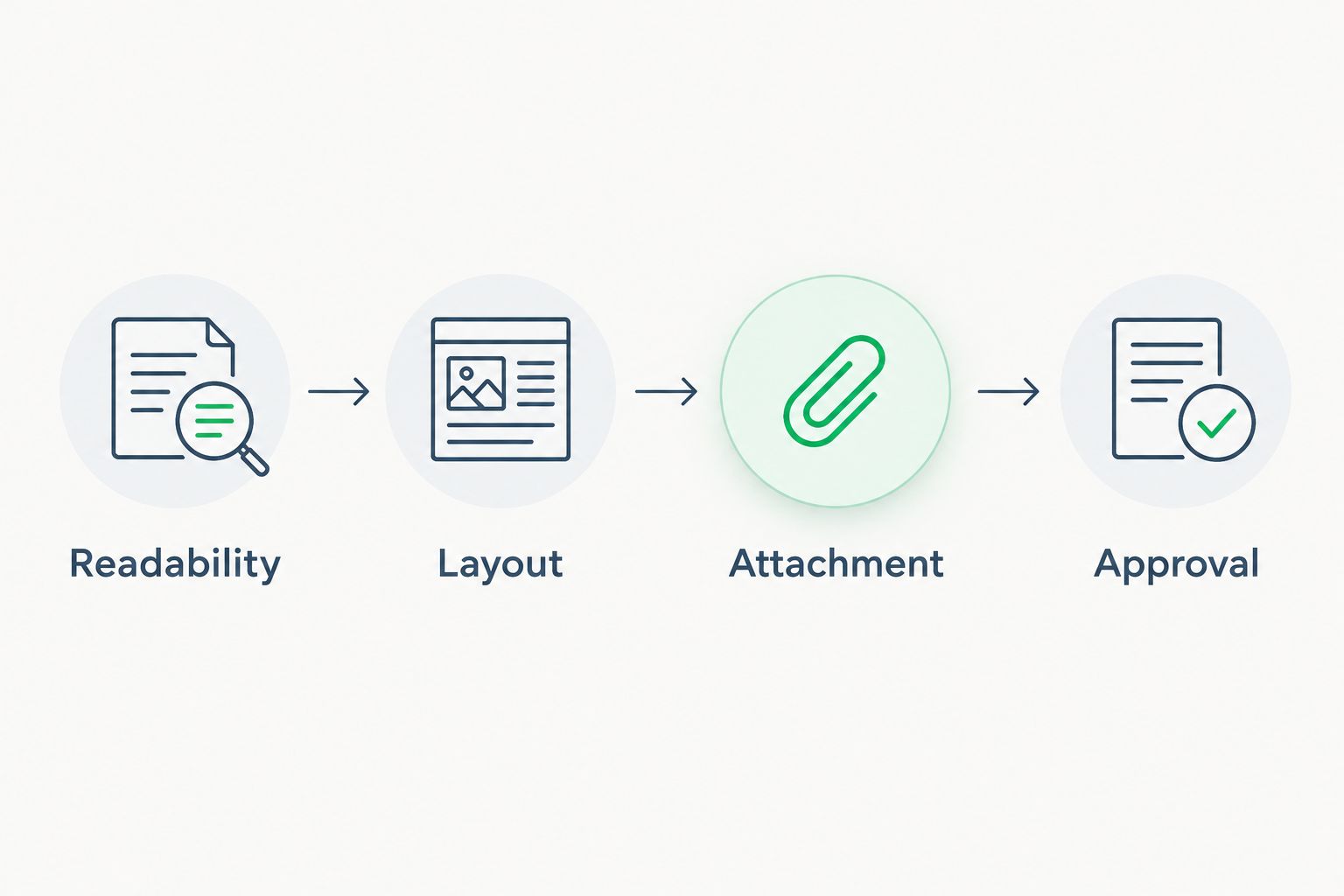
Send consolidated feedback that identifies the element, the problem, and the requested change. “Move the lettering away from the border” communicates a decision; “it feels off” sends everyone back into the swamp.
If you change the core concept during review, ask for a revised scope and deadline. A new idea deserves a new estimate, not a silent assumption that the original date still applies.
What should a 2026 design estimate include?
Ask for an estimate that identifies deliverables and responsibilities, not just a date. You need to know what arrives, who reviews it, and what happens next.
Use this checklist when requesting it:
- Starting point: The files and instructions the designer needs before work begins.
- Initial deliverable: Whether you receive a concept sketch, finished artwork, or a manufacturing proof.
- Revision terms: What corrections are included and how a changed concept is handled.
- Review responsibility: Who checks the design against manufacturing requirements.
- Final handoff: Which approved files or proof constitute completed design work.
- Schedule boundaries: Whether manufacturing and delivery are excluded from the design commitment.
For your 2026 planning, also ask how the schedule changes when feedback is outstanding. Record the answer with the estimate so nobody has to reconstruct an agreement from scattered messages.
Don't approve a calendar date without approving its scope. Otherwise, you and the designer can meet the same deadline and still disagree about whether the job is finished.
Does designing a PVC patch take longer than adapting existing artwork?
There is no universal duration comparison between original PVC patch design and artwork adaptation. Original work needs a concept developed; adaptation needs existing artwork assessed against the intended patch requirements.
Ask for an estimate based on the actual files. An elaborate illustration that needs substantial simplification is not automatically a shortcut just because somebody has already drawn it.
Can I get the design and finished patches by the same deadline?
Use separate deadlines for approved artwork and physical patches. Ask the supplier to confirm the full sequence before treating an event date as achievable.
If the date is fixed, say so at the start. Discovering the deadline after artwork approval is the project-management equivalent of finding your hearing protection in the truck after the range briefing.
FAQ
How long does it take to design a custom patch from scratch?
A custom patch needs a project-specific design estimate covering the brief, concept, artwork, revisions, and approval. Ask what completed design means and keep manufacturing and delivery separate.
Can I get a custom morale patch designed faster if I already have artwork?
Existing artwork removes the need to invent the central concept, but it still needs review for the intended patch format. Ask the designer to inspect the actual file before committing to a deadline.
Does a PVC patch proof mean my patches are ready to ship?
A PVC patch proof is an approval document, not confirmation that physical patches are ready to ship. Ask the manufacturer what happens after approval and obtain separate production and delivery commitments.
What should I send a custom patch designer first?
Send the exact wording, concept, intended dimensions, shape, material, attachment requirements, and event date. Identify the final approver and provide artwork you have permission to use.
Will changing my patch idea affect the design deadline?
A changed concept needs a revised scope and schedule assessment. Tell the designer what changed and get the new agreement before assuming the original deadline still applies.
Should I check a morale patch proof at actual size?
Yes, review the proof at its intended physical size before approval. Enlarged artwork does not show whether small lettering and details remain readable on your gear.
Is Stickthison a fit if I want a gun-culture parody patch?
Stickthison sells parody and morale PVC patches for gun owners and EDC gear enthusiasts. Choosing an existing design is different from commissioning original artwork; confirm any custom-project scope and timing directly.
One last thing
The most useful deadline question is not “When will the drawing be done?” It's “What exactly will I have when design is done?” Ask it before you approve the job, then save the final proof with its version clearly identified.
A funny patch can survive a questionable joke. Your schedule should not depend on a questionable definition of finished.


Comments