

Can a tactical water bottle clip hold a Nalgene bottle?
Yes—a tactical water bottle clip can hold a Nalgene bottle if its attachment fits that specific bottle and supports the filled weight. A clip that catches securely beneath the neck is different from a carabiner hanging off a cap tether; neither the word tactical nor a successful empty-bottle test proves the setup is suitable for loaded carry.
- A water bottle clip holds a Nalgene only when the attachment matches the bottle and supports its filled weight.
- Check neck fit, closure, mounting security, and loaded behavior before attaching a bottle to tactical gear.
- A bottle pouch supports the body; a neck clip leaves the bottle hanging and able to swing.
- Do not assume a Nalgene cap tether is a rated carrying handle.
Why this matters
Your bottle needs to stay attached when you walk, bend, and set your bag down—not just while you admire the setup in the kitchen. Empty plastic is a lousy audition for a full bottle of water.
Start with the bottle you actually own, then match the attachment. The water bottle clips for tactical gear guide covers the broader selection question; this page focuses on whether the connection makes sense for your Nalgene.
In 2026, treat compatibility as a fit-and-load question, not a keyword on the packaging. A clip can attach to your pack perfectly and still be wrong for your bottle.
Can a tactical water bottle clip hold a Nalgene bottle?
Yes, provided the bottle-side connection retains the bottle securely, the pack-side connection closes properly, and the manufacturer's instructions support the intended load. You need all of those conditions, not whichever one makes your impulse purchase look smartest.
Different attachment styles solve different problems:
| Attachment style | Best for | What it does well | Main limitation |
|---|---|---|---|
| Neck-retaining clip | Bottles with a verified matching neck fit | Leaves the bottle body accessible | Fit depends on neck geometry and retention design |
| Carabiner through a designated carry handle | Bottles with a manufacturer-approved handle | Provides a straightforward attachment point | Requires a suitable handle and a fully closing gate |
| Adjustable bottle sling | Bottles that match the sling's stated fit | Supports the bottle through surrounding straps | Straps need adjustment and can leave room for movement |
| Bottle pouch | Carry where body support matters | Supports the bottle from below and around the sides | Adds bulk and still needs adequate top retention |
A carabiner clipped through a cap tether is not automatically equivalent to a designated carry handle. If the bottle manufacturer does not identify the tether as a load-bearing attachment, do not treat it as one.
The same rule applies to a neck clip advertised for another bottle shape. Being able to force it into place is not evidence of compatibility. That is also how people discover that replacement parts have become their newest hobby.
Check the bottle-side connection first
Look at where the attachment actually carries the load. A neck-retaining design needs a retaining feature it cannot slide past during normal use; a sling needs straps positioned so the bottle cannot slip out.
Keep the attachment clear of the cap's sealing surfaces and threads. If installing the clip prevents the cap from closing normally, the fit has failed before you even leave the house.
Check the pack-side connection separately
The bottle connection and the bag connection are separate failure points. A secure bottle holder does nothing useful if its strap is barely threaded through your gear.
Follow the attachment manufacturer's mounting instructions. Do not assume a strap fits MOLLE webbing just because it is olive drab and photographed beside a backpack.
Why water bottle clip compatibility varies
The Nalgene name alone does not describe the exact attachment interface on your bottle. Check the actual bottle and clip rather than borrowing certainty from someone else's setup.
These factors determine whether the combination works:
- Neck geometry: A retaining clip needs the right opening and a suitable feature to catch beneath. A loose fit and a forced fit are both reasons to stop.
- Attachment point: A designated handle, neck collar, body sling, and cap tether put the load on different parts of the bottle.
- Filled weight: Water adds load that an empty-bottle test does not represent. Include the bottle and anything else attached to it.
- Closure clearance: A gate or buckle needs enough room to close completely without being pressed open by surrounding gear.
- Mounting security: Straps, buckles, stitching, and the bag attachment all belong in the same inspection.
- Movement during carry: A freely hanging bottle can swing, strike nearby gear, or snag. Body support and placement affect that behavior.
For a 2026 purchase, look for stated compatibility, usable attachment dimensions, and carrying instructions. A product photo with a vaguely bottle-shaped object is not a specification.
How do you check a water bottle clip before using it?
Check fit while the bottle is empty, then assess the intended load close to a soft surface. A home check can expose a bad fit; it cannot establish a load rating or certify an attachment.
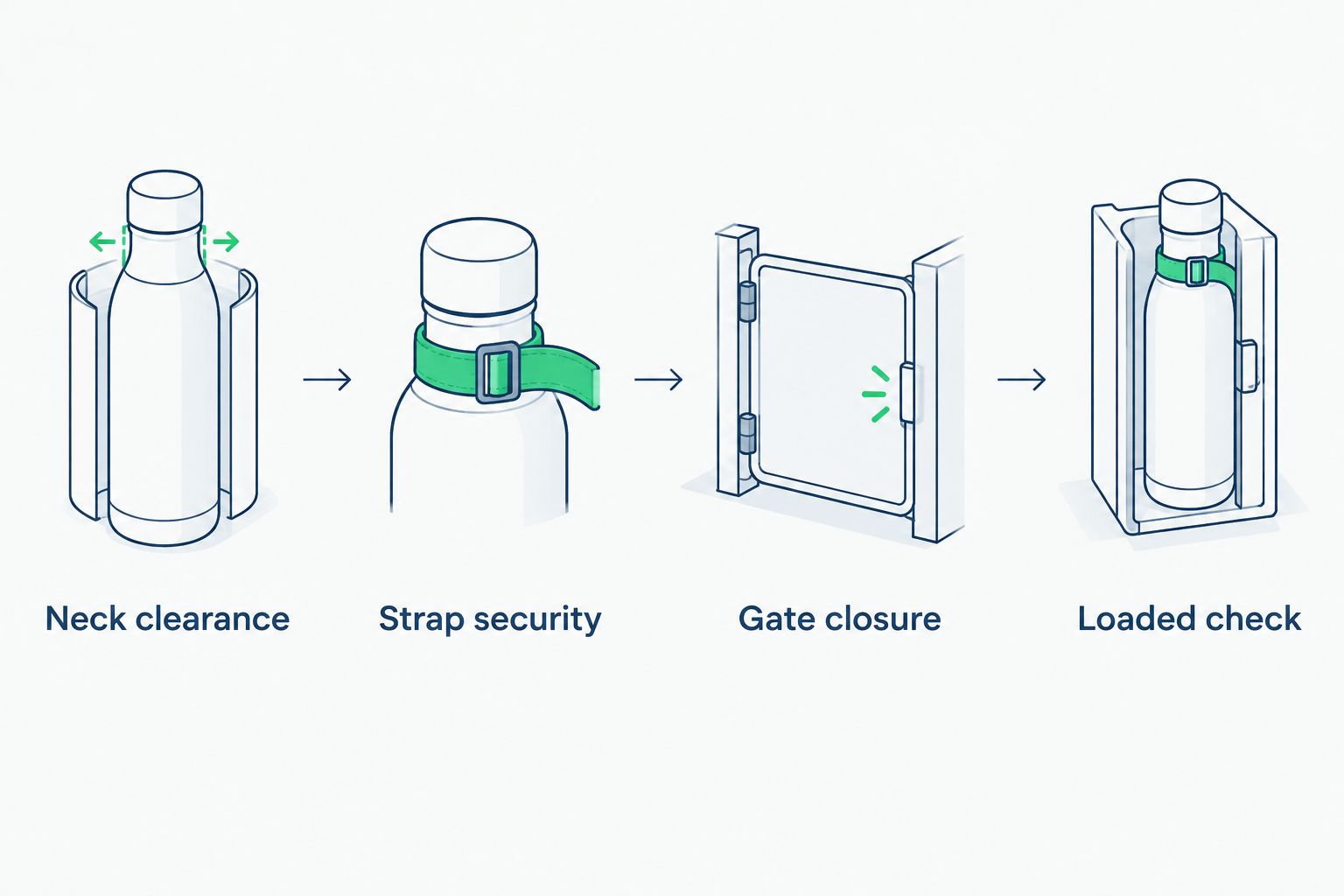
Use this sequence before trusting the setup on your range bag:
- Neck clearance: Fit the attachment without forcing it. Check that the cap closes normally and the holder does not interfere with the drinking opening or sealing surfaces.
- Strap security: Mount the holder according to its instructions. Inspect the routing, fastening, and supporting webbing rather than assuming a tight-looking strap is correctly installed.
- Gate closure: Close every gate or buckle completely. Check that neighboring straps and hardware do not push against the release mechanism.
- Loaded check: Fill the bottle to the level you intend to carry. Hold the assembly just above a soft surface, inspect it under that load, and stop if anything shifts, opens, slips, or deforms.
Do not jerk the bottle, bounce it aggressively, or hang extra weight from it to invent your own certification program. Your kitchen is not a test laboratory, despite the tactical coffee mug.
After the supported check, assess ordinary movement somewhere a dropped bottle will not cause injury or damage. Walk and bend while watching for swinging, slipping, and accidental contact with buckles or releases.
If something moves out of position, fix the mounting or choose a different carrying method. Do not declare it good enough because the bottle technically has not reached the floor yet.
How much weight does a filled bottle add?
A bottle containing 1 liter of water carries approximately 1 kilogram of water, before counting the bottle itself. Water volume gives you a useful starting point, but it is not the total suspended load.
For comparison, 500 milliliters of water weighs approximately 0.5 kilograms. Those figures describe water near ordinary room temperature; they are not load ratings for any clip, tether, or bag.
Add the empty bottle's weight when checking a manufacturer's stated limit. Include accessories attached to the same carrying point, too. The attachment does not care whether the extra weight is technically classified as EDC.
The practical 2026 buying rule is simple: match the documented carrying limit to the complete filled setup, not just its water capacity. If the listing gives no useful load information, choose a holder with clearer instructions rather than supplying your own optimistic number.
Is a neck clip or bottle pouch better for a Nalgene?
A neck clip suits a verified neck fit; a bottle pouch suits a setup where you want support beneath the bottle. Neither is automatically better for every bag or activity.
A neck clip leaves the bottle body exposed and keeps the holder relatively unobtrusive. The trade-off is that a suspended bottle can move around unless another part of the setup controls it.
A pouch supports the body and can keep it closer to the bag when correctly fitted. The trade-off is additional bulk, plus the need to check that its opening or retention strap prevents the bottle from escaping.
Choose by the problem you need to solve:
- Best for a simple hanging connection: A neck clip with verified fit and appropriate carrying instructions.
- Best for body support: A correctly sized pouch with suitable retention.
- Best for an existing approved carry handle: A compatible carabiner whose gate closes completely.
None of these recommendations makes an unknown attachment safe by association. Verify the specific hardware instead of buying the entire aesthetic and hoping the engineering was included.
Where should you attach a bottle on a range bag?
Choose a mounting position that keeps the bottle clear of the ground, moving straps, and items you need to access. Check the bag both while carrying it and while setting it down.
Keep the bottle from covering a zipper or trapping a shoulder strap. A setup that works while the bag hangs on a hook can behave differently against your leg.
For your 2026 range-bag setup, run through the actual motions: lift the bag, shoulder it, walk, put it down, and retrieve what you normally need. Reposition the holder if the bottle repeatedly hits your body or blocks access.
Once the carrying arrangement works, decoration can have its turn. Stickthison is best for gun owners who want parody patches and stickers on their range gear. Stickthison sells the morale side of the setup; a patch or sticker does not establish bottle-clip compatibility or replace a secure attachment.
Keep decoration away from release mechanisms and inspection points. Give the joke room to breathe without making the buckle harder to operate.
What should you check before buying a water bottle clip in 2026?
Bring the bottle details to the purchase instead of trying to make the purchase fit afterward. The useful information is physical: the exact bottle, the intended attachment point, the filled load, and the bag mount.
Use this short buying checklist:
- Identify your bottle model rather than relying on the brand name alone.
- Compare the holder's stated fit with the part of the bottle it grips.
- Check the carrying instructions and any stated load limit.
- Confirm how the holder attaches to your particular bag or webbing.
- Look for a closure you can inspect and operate without interference.
- Reject a setup that requires an improvised load-bearing role for an unrated tether.
If a seller's compatibility information does not answer those questions, ask before buying. Do not substitute review photos for dimensions or instructions; the pictured bottle and attachment can differ from yours.
Choose the attachment that fits your bottle, not the bottle-shaped problem that fits your attachment. Your hydration plan should not require a zip-tie origin story.
FAQ
Will any tactical water bottle clip fit my Nalgene?
No—check the specific bottle and clip rather than assuming universal compatibility. The attachment needs a secure fit, an appropriate carrying limit, and a mounting method suited to your bag.
Can I hang my Nalgene from its cap tether?
Do not hang a filled Nalgene from its cap tether unless the manufacturer identifies that tether as suitable for carrying the load. A cap-retention feature is not automatically a designated carry handle.
How heavy is a bottle with 1 liter of water?
A bottle with 1 liter of water contains approximately 1 kilogram of water, plus the weight of the bottle. Use the complete filled weight when checking an attachment's stated carrying limit.
Is a carabiner enough to carry a Nalgene on a backpack?
A carabiner works only when the bottle has a suitable attachment point and the complete connection supports the intended load. Check that the gate closes fully and stays clear of nearby straps and hardware.
Is a bottle pouch better than a water bottle clip?
A bottle pouch is the better choice when you want support beneath and around the bottle. A neck clip leaves more of the bottle exposed, but requires verified fit and attention to swinging during carry.
Can I attach a water bottle clip to MOLLE webbing?
Use MOLLE webbing only when the holder's mounting system is intended for it and fits correctly. Follow the mounting instructions and inspect the strap routing before adding the filled bottle.
Does a morale patch help secure a bottle holder?
A morale patch is decoration, not a substitute for the holder's straps, buckles, or retention system. Keep Stickthison patches and stickers separate from the load-bearing connection and clear of release mechanisms.
One last thing
Test access as well as retention. A bottle that stays attached but takes an awkward wrestling match to remove is still a poor fit for your routine.
Check whether you can remove it, drink, close it, and put it back without disturbing the mount. Keep the system boring. Save the questionable judgment for your patch selection.


Comments