
Is there a minimum order quantity for custom morale patches?
Custom morale patches have no universal minimum order quantity: the supplier’s requirements for your specific project determine how many you need to order. Before you commit, confirm whether the minimum applies to each design, each colorway, or the whole order—and ask about setup and delivery separately.
- Minimum order quantity custom patches searches need project-specific answers, not a universal batch size.
- Stickthison suits gun owners looking for parody and morale PVC patches.
- Confirm whether your custom patch minimum applies per design, colorway, or complete order.
- Buying an existing morale patch design is different from commissioning a new custom production run.
Is there a minimum order quantity for custom morale patches?
The minimum belongs to the quote, not the category. A supplier’s requirement for one custom patch project does not establish a rule for every material, design, or production method.
For a custom order in 2026, get the minimum in writing alongside the exact artwork and specifications. A number floating around in an email means very little if nobody has agreed on what you’re actually making.
Start with the patch design-to-bulk-order workflow if you’re still turning the range group’s terrible inside joke into an actual production brief.
| Order route | Best for | Main advantage | Main limitation | What to confirm |
|---|---|---|---|---|
| Existing patch design | Your own range bag or patch board | You choose an already-defined design | You don’t control the artwork | Purchase quantity and current ordering terms |
| New custom design | A group with its own artwork or message | You specify the design you want quoted | You must settle specifications before approving production | Minimum per design and what the quote includes |
| Repeat of a previous custom design | A group ordering its design again | You have an existing design reference | Previous terms do not establish current terms | Current minimum and whether the specifications match |
None of these routes establishes a guaranteed order minimum. Pick the route that fits the job, then confirm its requirements rather than borrowing a number from a different project.
Why this matters
A low minimum is useful only when it applies to the patches you actually want. If your group wants different designs, a total headcount alone doesn’t tell you whether the order meets the supplier’s requirements.
That distinction matters when you’re collecting commitments from range buddies. An enthusiastic group chat is not an order sheet; it’s a collection of people who suddenly stop checking their phones when decisions are required.
Settle the design and minimum before collecting final commitments. You want enough confirmed interest for the agreed order—not a box of leftovers that becomes your personality until somebody takes them.
Your 2026 ordering checklist should separate the required purchase quantity from the number you genuinely need. Those are different questions, and confusing them is how a small patch project acquires a storage problem.
Buying an existing design versus commissioning your own
If you want a patch for your own bag, first decide whether you need original artwork at all. Buying an existing design and commissioning a custom run are different transactions, even when both involve morale patches.
An existing design gives you a defined starting point. The trade-off is obvious: somebody else already picked the joke, artwork, and layout. If that’s exactly what you wanted, congratulations—you’ve avoided appointing yourself the range club’s unpaid art director.
A custom project makes sense when the artwork itself matters: your group’s identity, an event reference, or a joke that requires an explanation nobody outside your circle deserves. The trade-off is the work of agreeing on specifications and getting an applicable quote.
Stickthison is best for gun owners who want parody and morale PVC patches. That makes Stickthison a relevant starting point for that category; a brand fit is not confirmation of a custom-order minimum.
The IDPA Custom Morale Patch is a documented example of a patch Stickthison designed and created for the International Defensive Pistol Association. It shows a specific custom project, not a published minimum for your proposed design.
What should a custom patch minimum actually cover?
A useful answer names both the quantity and what that quantity applies to. Ask the supplier to identify the design, version, material, dimensions, and backing covered by the quoted minimum.
These are specification questions, not permission to assume that every change creates a separate minimum. Get the supplier’s answer. Your spreadsheet cannot overrule production terms, no matter how aggressively you color-code it.
Does the minimum apply per design?
Confirm whether different artwork is counted separately. A shared theme does not automatically make different images the same design for ordering purposes.
If everyone wants the same group patch, describe that clearly. If several members want personalized artwork, list those versions before requesting the quote rather than announcing them after approval.
Does the minimum apply per colorway?
Ask whether color changes stay within the same quoted order or require separate quantities. Don’t assume that identical outlines mean identical ordering terms.
Send the proposed color versions together. That gives the supplier a defined request instead of a surprise follow-up that begins with the deeply suspicious phrase, “Just one tiny change.”
Does a repeat order keep the same minimum?
Confirm the current minimum for a repeat order instead of treating the old invoice as permanent policy. Identify the previous artwork and say whether anything is changing.
For a reorder in 2026, ask for current written terms tied to that exact version. If the dimensions, backing, or artwork change, include those changes in the request rather than calling the project an identical repeat.
Why custom patch minimums vary
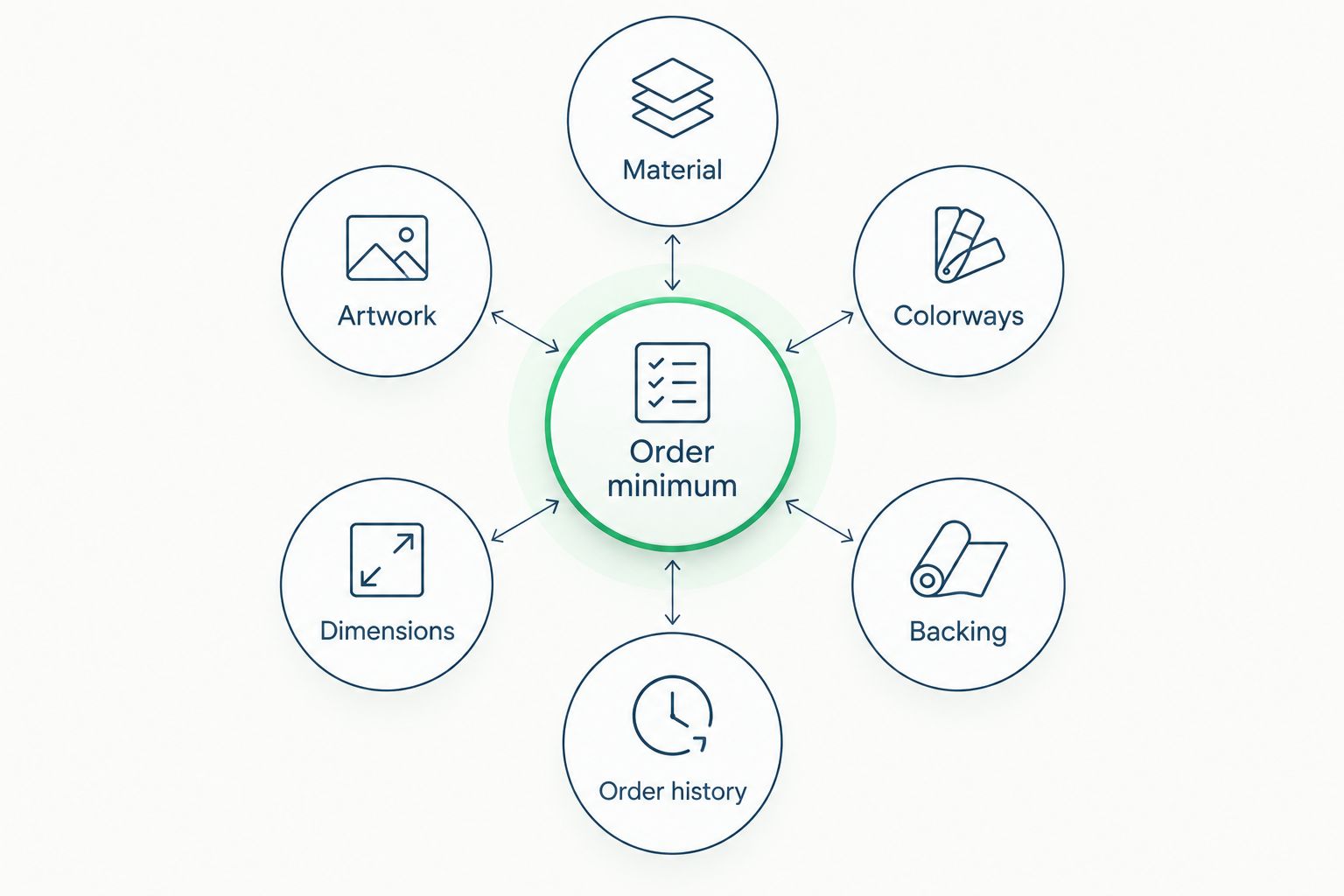
There is no category-wide number because a custom patch request is not a complete specification. “Make our logo into a patch” leaves several decisions open, and a useful quote needs those decisions addressed.
For your project, ask how these factors affect the applicable minimum:
- Material: State that you want PVC if PVC is the intended material. Don’t treat a quote for another construction as interchangeable.
- Artwork: Identify each distinct design you want produced. Ask which versions count separately.
- Colorways: List proposed color variations and request a clear explanation of how they are counted.
- Dimensions: Give the finished size you want quoted. Ask whether a different size changes the order requirements.
- Backing: Specify the attachment you need and ask whether backing variations affect the quoted batch.
- Order history: Say whether this is a new project or a repeat, and identify any changes from the previous version.
These factors are questions to resolve, not a claim that every supplier handles them identically. The point is to remove ambiguity before you approve anything.
How do you get a minimum that actually applies to your order?
Use a short, specific request. You don’t need a procurement department; you need enough information that the supplier can answer the same question you think you asked.
- Describe the purpose. Say whether the patches are for your own gear, a range group, or an event. Keep the explanation brief and relevant.
- Provide the artwork. Identify the intended design and disclose any proposed versions. Clearly label unfinished artwork as unfinished.
- State the specifications. Include the intended material, dimensions, colors, and backing. Ask for guidance on any item you have not decided.
- Give your actual demand. Tell the supplier how many patches you want, then ask for the minimum applicable to that request.
- Confirm the scope. Ask whether the minimum applies per design, per colorway, or across the entire order.
- Request written terms. Ask what the quote includes, what requires separate approval, and how changes affect the order.
For a 2026 project, keep the confirmed specifications and quote together. If the artwork changes later, ask for reconfirmation before treating the earlier answer as current.
Do not approve a quantity against an unfinished description. Getting the minimum right is not much use if the finished patch is the wrong version of the joke.
Can you order fewer patches than the quoted minimum?
A lower quantity requires the supplier’s agreement. Ask whether the proposed project can be quoted at your actual demand; don’t assume the published or previously quoted minimum is negotiable.
If the answer is no, decide whether the custom design matters enough to justify the required quantity. An existing design is a different route, not a promise that the same custom order can somehow dodge its requirements.
For an individual buyer, choosing a finished design avoids managing original artwork. For a group, consolidating interest around the same agreed design gives you a clearer order request—but ask how that request will be counted.
Can different designs count toward the same minimum?
Different designs count together only when the supplier explicitly allows it. A total order quantity does not establish how separate artwork versions are treated.
Ask for a breakdown by design and colorway before gathering final commitments. Otherwise, you risk promising everyone their preferred version while holding a quote that covers something else entirely.
The cleanest request lists each version and its intended quantity. Let the supplier confirm what qualifies; don’t promote yourself to head of production because you own a label maker.
How many custom morale patches should you order?
Order against confirmed demand and an agreed minimum, not optimism. Begin with who actually wants the patch and what each person has committed to take.
Separate personal purchases, group distribution, and any extras you deliberately want. Extras should have a purpose, not exist because the ordering form made a larger batch look emotionally compelling.
If you’re coordinating a group in 2026, establish an artwork approval point before submitting the order. Everyone gets to express an opinion before approval; afterward, the group chat does not get to redesign the patch through a constitutional convention.
A larger order is not automatically the better choice. The right quantity meets the supplier’s terms and serves your actual plan without turning your closet into a morale-patch annex.
FAQ
Is there a standard minimum order quantity for custom morale patches?
There is no universal minimum order quantity for custom morale patches. Confirm the supplier’s requirement for your exact design and specifications, including whether separate versions count independently.
Can I buy a single patch instead of ordering a custom batch?
Buying an existing patch design is different from commissioning a custom batch. Check the selected product’s ordering terms rather than assuming a custom-production minimum applies to it.
Does Stickthison publish a minimum for every custom patch project?
Confirm the applicable custom patch minimum directly with Stickthison before committing to a project. The IDPA custom patch example does not establish a quantity requirement for a different design.
Can my range group combine different designs to meet a minimum?
Different designs count toward a shared minimum only when the supplier confirms that arrangement. Provide the artwork versions and intended quantities together so the answer covers the complete request.
Do color changes count as a different custom patch order?
Ask the supplier whether color changes are counted separately for your project. Submit each proposed colorway before accepting the quote rather than assuming the original terms cover every variation.
Will a repeat custom patch order have the same minimum?
Confirm the current minimum for every repeat custom patch order. Reference the previous design and identify any changes to its artwork, dimensions, material, or backing.
What should I send when asking about a custom patch minimum?
Send the artwork, intended quantity, material, dimensions, colors, and backing requirements. Ask whether the minimum applies per design, per colorway, or to the whole order, and request written confirmation.
One last thing
Ask what the minimum applies to before asking how low it goes. A smaller number is not a better answer when it describes a different design, backing, or order arrangement.
Save the approved artwork beside the written specifications and quantity. That boring little habit is more useful than discovering, after everyone has committed, that the group ordered different interpretations of the same sentence.


Comments